Thirty something reader, writer, and music lover who believes all people should have the freedom to espresso themselves however they choose. This community is born out of an equal love of reading, writing, and the power of faith and coffee.
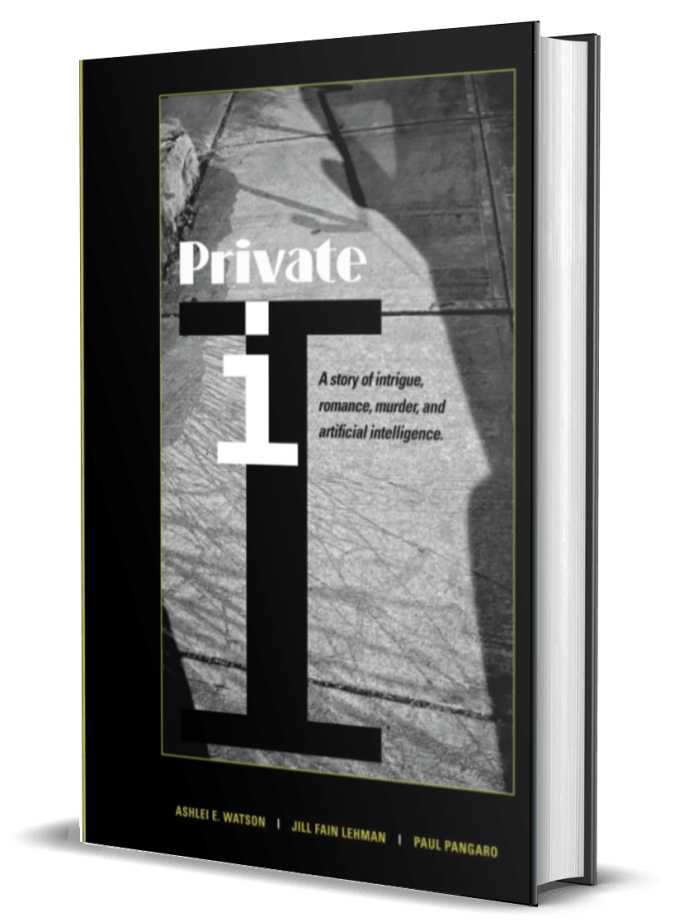
“Private I” is a gripping new adult thriller that weaves together elements of intrigue, romance, murder, and artificial intelligence. The story follows Paloma, a young woman on the brink of starting her college journey in Machine Intelligence (MI) at MITI, hoping to build upon her grandfather’s secret technological innovations. Her plans are violently derailed when she returns home to find her grandfather tortured and killed, with evidence suggesting his murderers were after Marlowe, Paloma’s MI companion of 15 years.
Forced to go on the run, Paloma must navigate a complex web of potential threats – from tech corporations to government agents to anti-tech terrorists – while protecting both herself and Marlowe. The novel explores contemporary questions about machine consciousness, human-AI relationships, and the societal implications of advanced artificial intelligence through a noir-inspired lens. What sets “Private I” apart is its unique dual narrative, featuring the internal monologue of both Paloma and her AI companion, offering a fresh perspective on classic noir themes while addressing today’s headlines about AI development and its impact on society. In a world where AI is no longer just a buzzword but a reality that has reshaped every aspect of society, “Private I” explores the very real implications of machine intelligence on human trust, relationships, and accountability. The novel is an unflinching look at how we navigate a future where the lines between human and machine are increasingly blurred. For fans of speculative fiction and sci-fi thrillers, “Private I” offers a gripping narrative that combines edge-of-your-seat mystery with profound philosophical questions about AI and humanity. It will appeal to readers who enjoy complex, thought-provoking stories like those of Philip K. Dick, William Gibson, and other tech-noir pioneers. Tech enthusiasts will be excited by a new take on AI’s evolution and its implications for personal relationships, while lovers of psychological thrillers will appreciate the tensions among human characters in a world fractured by its willingness to be dominated by intelligent machines. “Private I” will resonate with readers who are fascinated by AI, technology’s role in society, and the ethical quandaries that will soon be upon us all. It’s a compelling blend of mystery, noir, and thriller, all wrapped in a deeply human story about love, betrayal, and survival. If you’ve ever wondered what happens when machines think like humans and humans have to trust machines with their lives…this book is for you.
“Private I” is available on Amazon. The authors are grateful for any reviews you can share on Goodreads and other social media platforms!
Ashlei E. Watson is an American novelist, known for her work that blends speculative fiction with deep philosophical themes.Jill Fain Lehman, PhD, is a Senior Project Scientist at Carnegie Mellon University’s Human-Computer Interaction Institute with over 40 years of experience in artificial intelligence, natural language processing, and machine learning. She has collaborated with leading organizations like Disney Research, The Rand Corporation, and Carnegie Learning. Jill is the co-author of Private I, a speculative fiction novel exploring the complexities of AI, consciousness, and trust.Paul Pangaro, PhD, is an entrepreneur, researcher, and educator with over 30 years of experience applying cybernetics to human-machine systems. He has founded multiple startups and now teaches at Carnegie Mellon University, where he is establishing a Laboratory for Cybernetics.
No, this is my second novel and fourth book. Journey to 2125 was released on September 30th.
Let me describe this book in the context of my first novel, and the entire project surrounding AI and robotics that the two novels together explore. My first novel, Unfettered Journey, attempted to realistically imagine the world of 2161. By then, I guessed that – at long last, though science fiction writers have already been imagining it for a century – robots would be walking among us and doing many of our jobs. The central question was: could those AIs embodied in robots attain consciousness? My studies in philosophy of mind encouraged that question, and I explored it in the form of a novel, with characters with whom the reader could feel an empathetic connection.
I thought that was my only novel. But fans were taken by that highly realistic world, and asked, “How did we get there?” That question, and the rapid development of AIs caused me to consider a second novel. I was driven to it when I realized that multiple problems were on humanity’s doorstep this century, and fiction writers did not appear to be helping to focus attention on them.
That is the impetus for my latest book, Journey to 2125. It tells a story of this next century, told through the lives of a family, of how they meet the challenges brought on by accelerating technological change. The story focuses on a grandfather, Max MacGyver, and his long-separated grandson, as Max reveals the family secrets and tells their story.
2. What do you hope people gain from Journey to 2125?
That is best answered by the epigraph in my novel, Journey to 2125. Which is:
Of the many challenges ahead this century,
a few matter.
Focus on and overcome those few,
and you, yours, and the world
will survive, and perhaps even thrive.
Facing accelerating change this century, humankind needs to be strategic, to focus on the most pressing problems. I give my list of those key problems in the novel. My readers can watch my characters respond to the world and these problems, that I really believe we will see coming to fruition. We need to stop talking about them endlessly, and instead we need to solve them.
3. What role does technology play in politics?
Technology will continue to play a role by changing the playing field in how candidates get elected. For example, FDR used the new technology of radio in his day. Kennedy mastered the television debate, arguably for the win in 1960. Social media has played an enormous role in the last three presidential races, for good and evil. In Journey to 2125, I describe the use of “digital twins” being used to sway an election. Technology and its impact, especially on the survival of democracy, must be carefully considered. That is one lesson of the novel.
4. What do you like to do when not writing?
My wife and I love to travel, having visited over 130 countries. Most recently we spent October in the Caucasus, and were in Georgia when the elections were underway. Sadly, the pro-Russian forces stole the election, and now the country is turning away from the EU. We travel to better understand the world, in all its complexity. I sit on two nonprofit boards, for the Exploratorium of San Francisco, and for the Santa Fe Institute, focused on complexity studies and cross-disciplinary research. I have an observatory in the Sierra Nevada foothills, where we run astronomy field trips for high school students. And I enjoy making a nice Cabernet wine at our vineyard in Napa, where I also raise bees.
5. Do you trust AI?
“Trust” is an interesting word to use, suggesting something human-like, with human-style consciousness. From my philosophical training, I think machine consciousness will not appear anytime soon. But well before that, we need to worry about the loss of jobs and that impact on our economic society.
The question is perhaps seen in the context of those who are worried that AGI – artificial general intelligence – would be achieved very soon in AIs, and then the machines would be able to replace us. The replacement image conjured is of some Terminator-like invention.
Two years ago, we had the “chatGPT moment” when the technology demonstrated a dramatic leap. Roughly one hundred billion dollars has since flowed into AI companies. It is clear that the technology will dramatically change many jobs and replace many people. My expectation is that over the next two decades jobs will be redefined, many will disappear, and many new jobs will be created.
We will also learn the limitations of the AIs. The AIs will make mistakes. Some mistakes will be costly in human injury and money. I doubt that very many sectors of the economy will operate with AIs who have no human oversight. And I do not expect any Terminator to walk down the street any time soon.
Notwithstanding the astonishing capabilities of AI technology, I suspect we will see the limits showing soon. I follow long-time AI researcher Melanie Mitchell at the Santa Fe Institute, and her questioning of the current exuberance. We need be cautious about the AI hype.
That is the shorter-term picture. How long will it take for “true” artificial general intelligence? That depends upon one’s definition of AGI. I suspect that some AGI definitions leave too many loopholes to allow a claim that AGI has been reached. But what do we really fear? I cover that topic in my book, Journey to 2125, with a careful definition in the glossary.
Two primary human fears surround the attainment of AGI by a machine. First is the fear that achieving “strong AGI” leads to the replacement of humans and, at a minimum, the need to address moral and ethical responsibilities to AGIs as fellow sentient or conscious creations. Second is the fear that AGIs will replace most human jobs.
Regarding the second fear, perhaps a useful working definition would be that a practical economic AGI is a computer AI, deployed with ecological validity in economic settings that is recognized as consistently performing, un-aided by any human, a reasonably complete set of capabilities superior to those possessed by an intelligent 25-year-old educated person. Capabilities include the ability to learn and adapt goals in a dynamic environment.
The definition of practical economic AGI focuses on the fear of human economic displacement. I think that the tsunami of job losses to AIs will not occur until robots have been sufficiently refined, made cheap enough, and capable enough to walk among us. Then they will transform the economic system. That second wave, which I do not foresee until the latter half of this century, is a central theme of Journey to 2125.
What about attainment of “strong AGI,” when AIs (certainly embodied in robots) might begin to reach sentience, or even some sort of consciousness? My studies in theory of mind (from my MA in philosophy) suggest that will not occur until the next century at the earliest, and perhaps more likely much farther in the future. The “hard problem of consciousness” (a term coined by David Chalmers in 1995) is indeed very hard. That’s the subject of my first novel, Unfettered Journey. Both novels attempt to make this complex technology more understandable, more concrete when described in the form of story, with a realistic, hard-science approach.
Gary F. Bengier is a writer, philosopher, and technologist with a deep interest in how technology and human experience intersect. After a notable career in Silicon Valley, including his role as eBay’s Chief Financial Officer, Bengier pursued his passion for astrophysics and philosophy. His previous work, “Unfettered Journey,” earned acclaim for its philosophical depth and realistic world-building. His latest book, “Journey to 2125” is hailed as a visionary masterpiece that blends compelling storytelling with thought-provoking insights on climate change, technological advancement, and the future of humanity. Through a richly crafted family saga, Bengier paints a vivid picture of our potential futures, challenging readers to reflect on their role in shaping a sustainable and harmonious world.
Love is Deceiving is a contemporary romance novel by Jessica Jude Ziegler and Jacqueline Farrugia Masotto. It tells the story of Army Commander Rob Stevens and US Marine Ellie Walker, who falls in love despite suffering from memory loss after a combat injury.
Interview Questions
1. What is the experience of having a co-author like? There are a lot more positives than negatives when working with a co-author. You have a soundboard and elaborate ideas, scenes, and storylines. It helps because you do not feel so alone in the process. On the other hand, working with a co-author creates tension because life gets in the way, and you have to make time for them. Overall, it is a well-worth experience.
2. Love is Deceiving has a military storyline or tie. Do you have any ties personally to the military? I do have ties with the military. In my line of work as a police officer, many have transitioned from a military career to police work. We work well together and have similar tales to tell.
3. What do you like to do when not writing?
Working I work a lot often six days out of the week. I also enjoy listening to music, reading a good book, having a nice conversation over a hot cup of coffee, and playing with my dogs.
4. What do you hope people gain from reading Love is Deceiving?
I would like people to relax and get lost inside of my book. I want to identify with the characters and cheer for the good guys and boo for the bad guys. I just would like it to be a bit memorable.
5. The sequel is almost ready for release. What do you want readers to know about it?
I want to know the story goes on. Love is part of what we want in our life. Love is not easy free or cheap. However, I want the readers to enjoy it, cherish it, and aspire to have romance. Honestly, I want them to forget the world and get lost in between the pages of the book.
As a business owner, you often wear multiple hats, and handling your marketing efforts is one of the most impactful. Developing a keen understanding of effective marketing strategies can significantly enhance your business’s visibility and engagement. Crafting these strategies involves examining your existing methods, focusing on your intended audience, and continuously adjusting your approach based on performance metrics. In this article, courtesy of The Smart Cookie Philes, you’ll discover practical steps to manage your marketing tasks efficiently and effectively.
Assessing Your Current Marketing Strategies
Start by critically assessing your current marketing strategies. Are your current efforts meeting the goals you’ve set for your business? This analysis can illuminate areas that require enhancement or change. Keeping your marketing aligned with your business goals is crucial, and periodic assessment is vital in ensuring your marketing efforts remain effective.
Enhancing Skills Through Education
Returning to school for a business degree can significantly sharpen your marketing and general business skills. Online programs offer the flexibility needed to continue managing your business while you study, and you can check it out for more info on how these programs cater to entrepreneurs. Acquiring a marketing, business, communications, or management degree equips you with a deeper understanding of business operations and strategic thinking. This education can be a powerful tool in enhancing your competitive edge in the market.
Identifying Your Target Audience
Understanding who your products or services are meant for is the cornerstone of effective marketing. Pinpointing your audience allows you to craft messages that resonate deeply with them. This focus enhances engagement and increases the efficiency of your marketing spend by reducing wasted resources on uninterested parties. Moreover, knowing your audience can lead to more personalized and impactful marketing strategies, fostering brand loyalty and long-term customer relationships.
Leveraging AI for Visual Content Creation
Using AI to generate compelling visual content can significantly simplify your marketing processes. These tools, including a free AI art generator online, allow you to create specific images that align with your branding without extensive graphic design skills. This accessibility speeds up content production and lets you meet the demands of various marketing platforms efficiently. The ability to quickly produce high-quality visuals can give your campaigns a significant advantage in capturing audience attention.
Selecting Appropriate Marketing Channels
Determining whether your current channels are reaching your audience effectively is critical. Switching to different platforms or trying new communication mediums could capture a broader or more appropriate audience. Testing various channels can uncover more effective ways to connect with your target market. Additionally, regularly evaluating and adjusting your channel strategy ensures that your marketing efforts remain relevant and aligned with evolving consumer behaviors and preferences.
Refining Your Marketing Messages
Your marketing message should communicate the value your business provides. Refine this message to be clear, compelling, and targeted toward the needs and desires of your audience. Effective messaging captures what makes your offerings unique and why they are the best choice for your customers.
Tracking Marketing Performance
It’s crucial to track the effectiveness of your marketing strategies. Use analytics tools to monitor various metrics, such as engagement rates, conversion rates, and overall return on investment. This data will guide you in making informed decisions about future marketing strategies and budget allocations.
Taking control of your marketing efforts can lead to more tremendous business success. By assessing and adjusting your strategies, focusing on your target audience, embracing new marketing channels, refining your messages, and tracking your results, you set your business up for enhanced visibility and engagement. Additional education can further develop your skills, ensuring you stay competitive and informed. Managing your marketing effectively means continuous learning and adaptation, but the benefits to your business are invaluable.
In July 2024, the lovely Lola Beth of Umbrella Local PR reached out to me to ask if she could write an article about my PR firm and Publishing company…you can read it here.
James W.A. is no stranger to epiphanies but recently he received his first credit in a literary magazine in Tampa based bi-annual journal Neptune. His poem, Words Amongst Ashes, talks about his life as a writer, and all that it encompasses. You can check out his and other poets work in the newest issue of Neptune which you can find at the following link: https://www.blurb.com/bookstore/invited/10229810/dde501e6de9c36500760aeb56a92d696b0fbc39a Congratulations James at such an epiphanic achievement.
About the book:
In his sophomore title and first pure poetry collection, James W. A. explores the duality
found in the journey of one’s soul. Drawing from his own history, observations, and
imagination, he conjures the misery of younger days, the peace of more mature ones,
and the meanings of life and love in both. Found within these pages are stories,
musings, dreams, hopes, and emotions that show a progression from sorrow into joy,
and the shades of each in the other. Pour a glass, open your heart, and prepare to
venture forth with the titular concepts to experience for yourself the darkness of
Desolation and the triumphant elation of Epiphany.
About the Author:
James W. A. was born, raised, and lives in the Tampa Bay area. After graduating from the University of South Florida, St. Petersburg’s Honors College, he
published his first book, In the Library, in 2015. Since then, he has honed his ever-
evolving, contemporary style, both creatively and as a professional content writer. While
moving away from the dark subjects of younger days, James W. A. seeks to use his
experiences, joys, sorrows, and wonders he sees in the world around him to lead others
to truth and beauty and share meaningful stories to last the ages.
The author is available for interviews, readings, appearances, and features. For bookings and information, contact his publicist at chelseadevries@thesmartcookiephiles.com
James W.A. recently won two Bookfest Awards for his second collection Desolation and Epiphany. He won both for Outstanding Cover Art, Second Place and Contemporary Poetry-Modern, Third Place. Both awards were awarded during the Spring Bookfest Ceremony ending on April 7, 2024. You can see a list of past and previous winners on Bookfest’s website here: https://www.thebookfest.com/book-awards-spring-2023-first-place/ Congratulations to James and artist Ashton Lay for their subsequent award wins.
About the book:
In his sophomore title and first pure poetry collection, James W. A. explores the duality
found in the journey of one’s soul. Drawing from his own history, observations, and
imagination, he conjures the misery of younger days, the peace of more mature ones,
and the meanings of life and love in both. Found within these pages are stories,
musings, dreams, hopes, and emotions that show a progression from sorrow into joy,
and the shades of each in the other. Pour a glass, open your heart, and prepare to
venture forth with the titular concepts to experience for yourself the darkness of
Desolation and the triumphant elation of Epiphany.
About the Author:
James W. A. was born, raised, and lives in the Tampa Bay area. After graduating from the University of South Florida, St. Petersburg’s Honors College, he
published his first book, In the Library, in 2015. Since then, he has honed his ever-
evolving, contemporary style, both creatively and as a professional content writer. While
moving away from the dark subjects of younger days, James W. A. seeks to use his
experiences, joys, sorrows, and wonders he sees in the world around him to lead others
to truth and beauty and share meaningful stories to last the ages.
The author is available for interviews, readings, appearances, and features. For bookings and information, contact his publicist at chelseadevries@thesmartcookiephiles.com
Technically I don’t write poetry, I am certain that it writes me, or forces me to write it. Words are constantly circling my mind, as if they are creating a story and it’s my responsibility to then write them down. It was never my desire to write poetry. Somewhere in my teenage years it just became clear that I was given a skill set in this life, and I decided to take the time to nurture and attempt to improve this ability that was given to me by the universe. Over the years I have studied and educated myself on different forms of writing, which is why I like to call myself a creative writer. I am currently finishing up my MFA in creative writing, poetry and fiction, and have taken courses in film and television writing in the past. But poetry is my first choice and what comes naturally to my mind. Writing poetry helps me deal with my emotions and to better process this life through the act of writing poetry.
2. Tell us about your most recent collection.
My only published collection to date is entitled: Notes I Wrote Along the Way, which was published back in October 2020. The collection holds 50 poems written in English and Spanish, and focuses on themes such as life, death, purpose, love and letting go. I will say, if I were to do the collection today, I would rework them and restructure the poems to match my current writing style. I think that is a process most writers must deal with, looking back at older work and realizing how you would change some things and edit them to match the growth of your writing style. Currently, I am working on a collection of 75 poems that I started to write while working on my MFA. I am hoping to have them published in the near future.
3. Give the backstory behind one of your poems
Often, I like to write about painters, poets or writers that I am fond of and in one ekphrastic poem entitled: My Artistic Loneliness, which is based on the painting of Edward Hopper. The poem focuses on the loneliness of the characters painted into each poem, and then connected to my own feelings of loneliness and I am connected to those characters in each painting.
4.Who are 3 poets you always recommend?
Pablo Neruda, Charles Bukowski, and Joanne Kyger are three I would recommend at the moment. Neruda is a poet that I recommend often, especially if you are looking for love poems. Bukowski is a poet that I am new to, but I love the realness and authenticity of his words and statements he makes in his poetry. Kyger is a poet that I read in a poetry course recently, and I found the structure of her poems to be interesting and unique, and so I have tried to mimic that in some of my poems as of late. I think it’s important to read a wide variety of poetry from different authors, as it will help you with your own writing and to gain inspiration that can be implemented into your poetry.
5. I am currently reading….
Currently, I am reading Another Country by James Baldwin. I tend to read more for guidance or wisdom, rather than reading for fun. I am currently working on my MFA thesis which is a fiction novel, so I prefer to read the genre that I am writing in order to gain some insight to writing and expand my knowledge of writing through great books from great writers.
This is an exclusive interview with Matthew Gutierrez to commemorateNational Poetry Month. The Smart Cookie Philes is a small business and PR firm dedicated to helping indie authors and musicians espresso themselves.
For marketing services and to request my PR deck, email chelseadevries@thesmartcookiephiles.com
I write poetry because I have to! It is what’s most natural for me, and it’s been that way for most of my life. When I write fiction, there is a lot of planning, plotting, and forethought, whereas my poetry is written in flourishes of inspiration and spontaneity. I began writing poetry seriously when I was deployed to the Middle East as a soldier, as a means of self-preservation and self-medication, and I suppose all these years later, I still write poetry for the same reasons.
Additionally, as my writing has matured, an added focus has evolved in which I wish to show the sacredness of our shared world and our existence on it. And I endeavor to bring my readers with me to the places I travel to and explore.
Tell us about your most recent collection.
My most recent release is my poetry collection Purgatory, released in January 2024. My sixth published full-length poetry collection, Purgatory is perhaps most heavily influenced by the poetic works of Dante Alighieri and the holiness I find interwoven in the mountainscapes of the American West, where I live and explore. Dante’s The Divine Comedy has been the most influential work of literature I’ve read. I read it once a year and every time I take away something new. My last three poetry collections have all been influenced by The Divine Comedy, but Purgatory really doubles down on the journey from despair and suffering toward healing and acceptance. It has already been my most successful book, spending quite some time as the #1 New Release in American Poetry on Amazon, and the reviews for it have so far been a pleasure to read.
Give the backstory behind one of your poems
My poem “Tomato” from my collection Purgatory seems to already be a favorite among my readers. It’s one of several long poems contained in Purgatory. There’s a lot to unpack in this poem, which was written primarily in the spontaneous composition style championed by Jack Kerouac’s poetry. It’s a poem about rejuvenation, healing, and regrowth after destruction, comparing a relationship healing to the new verdant growth that rises from a landscape after wildfires. During the time I wrote the rough draft of “Tomato” my wife and I were growing tomatoes in our garden at my home, so that imagery got interwoven into the context of the poem as well. Like the collection Purgatory as a whole, “Tomato” shows that overarching journey in a microcosm, recovery and growth after suffering.
Who are 3 poets you always recommend?
I would say Dante Alighieri because his The Divine Comedy changed my life. I’d also say my other favorite epic poets, John Milton, Virgil, Walt Whitman, and Homer. But any of those can be a tall order to dig into, and epic poetry isn’t for everyone.
So, I suppose I would recommend to modern poets and poetry lovers: Jack Kerouac (who’s wild and spontaneous poetry has heavily-influenced my own), Gary Snyder (who so perfectly blends the themes of nature, sacredness, and adventure in his poems), and Swedish indigenous poet Linnea Axelsson (who has written what I consider to be the finest poem of the 21st Century, the epic poem Ædnan).
I am currently reading….
I am currently reading Cockeyed Happy by Darla Worden. I picked up this hardcover nonfiction book at a bookstore in Jackson Hole, Wyoming in late March. It’s about Ernest Hemingway’s Wyoming adventures in my state of Wyoming with his second wife. I’m already familiar with Hemingway’s excursions and adventures in Wyoming’s Yellowstone region and in the Bighorn Mountains of north-central Wyoming, where I frequently hike and go backpacking. But the additional details and research undertaken in this book have been fascinating, even for a longtime Hemingway aficionado like myself who thought I’ve learned all there is to know about the greatest fiction writer of the 20th Century.
This is an exclusive interview with Nicholas Trandahl to commemorateNational Poetry Month. The Smart Cookie Philes is a small business and PR firm dedicated to helping indie authors and musicians espresso themselves.
For marketing services and to request my PR deck, email chelseadevries@thesmartcookiephiles.com
Well I started writing poetry during lockdown 2020. By taking the time to understand nature better the words just came, almost as photographs. So I wrote, I found it a way to get emotions from my head. I joined and later became an admin of a Facebook Poetry Group called Dark Poetry Society,where i soon learned to write many different genres and interact with poets on a daily basis.
In short :
Poetry massages my mind and is a spring cleaning of my soul.
2. Tell us about your most recent collection.
The second book I released is called The Saga of Sir Bumble and Tales From the Butterleaf Realm. Part of what will be my inner child series it is meant to appeal to a wider audience.. from 8 to 80 and maybe more. It puts animals and insects centre stage and whilst it reads like a poetic novel
It has many messages and lessons to teach.
3. Give the backstory behind one of your poems
The Saga of Sir Bumble. A Bumble bee who has no sting. As a drone he would normally idle is time away waiting for a chance to mate. Not this guy, he became a poet Knight, grabbed a Holly leaf for a shield and a hawthorn for a lance and off he went.The quest for the sacred honey tree.
The idea came from sitting in the garden in lockdown when a hive of bees set up In the eaves of my house and I became intrigued at their behaviour. Hopefully while giving many characters human like traits, the Saga reads something like a chivalrous pursuit of adventure.
4. Who are 3 poets you always recommend?
Always I have to mention the masters first
Frost, Longfellow and of course Edgar Allan Poe. They have helped to guide my journey
But I now read a hundred or so poems a day from modern poets.
4. Who are 3 poets you always recommend?
Always I have to mention the masters first
Frost, Longfellow and of course Edgar Allan Poe. They have helped to guide my journey
But I now read a hundred or so poems a day from modern poets.
5. I am currently reading….Not Poetry but I am in the middle of The Wheel Of Time series by Robert Jordan, a 14 book series that creates a world of fantasy rivalling Tolkein’s Middle Earth. Those keep me sane after my daily dose of poetry, my admin duties and of course writing my own poetry and ‘ Sinister Short Stories.’
My first collection ‘ My Black Swan Calling’
Shows a little of my darkside as well as my affinity for nature.My books, as have my poems, are evolving and I have a number to be proof read and published when time allows.
This is an exclusive interview with Carl Butler to commemorateNational Poetry Month. The Smart Cookie Philes is a small business and PR firm dedicated to helping indie authors and musicians espresso themselves.
For marketing services and to request my PR deck, email chelseadevries@thesmartcookiephiles.com