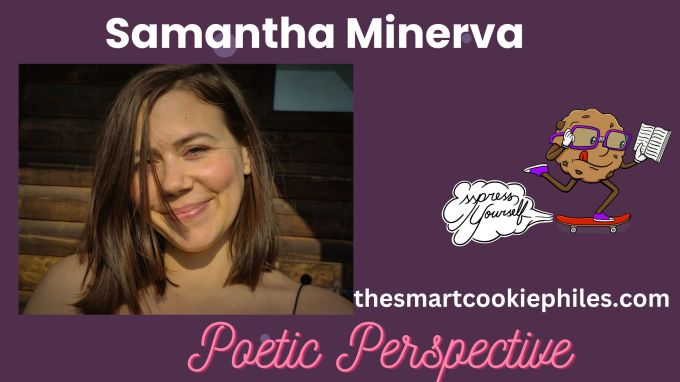
I didn’t choose poetry. When I put pen to paper, poetry is just what happens. I wrote my first poems when I was 13, but they were dark and my mom read them from my diary. I was so angry and ashamed I never wrote again until these books poured out of me at 31.
2. Tell Me About Your Most Recent Collection.
2. My most recent collection is a culmination and explosion of all of the feelings and expressions I had stuffed down my whole life. I hit a wall in my life and needed an outlet. I did not write with any intention of publishing whatsoever until book 3. Books 1 and 2 were written together within just a couple of weeks.
3. Give the backstory behind one of your poems
The first poem in book 1 was a profound experience for me. It was the day I finally let myself write again after all of those years and the way it flowed out of me felt like it wasn’t even me writing. This is the case for all of my poems. It feels like a channeling experience when I write, like a perfect mixture of my creative and logical sides creating magic together.
4. Who are three poets you always recommend?
Ironically, I actually don’t read or enjoy poetry very much. Never have!
5. I am currently reading…
I am currently reading a lot of kids books, as a mom to two little girls 🙂 My personal genre is mostly metaphysical, esoteric, psychology, etc.
Look for a review of Samantha’s collection coming soon to our Instagram and Facebook pages.
Every year in honor of National Poetry Month, I offer FREE review and feature for independent and traditionally published poets. This is a FREE feature to celebrate the power and brilliance that is poetry and those that create it. To hire me for contracted marketing and promotion for your music or books, contact me here to get started. To say thank you for this post, consider buying me a coffee.
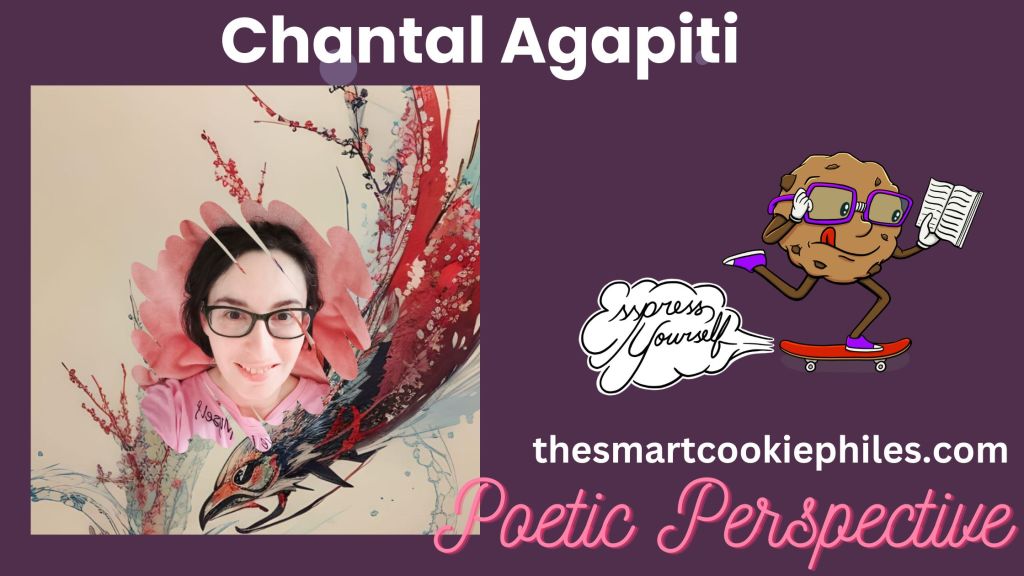
Poetry is such an untamed form of expression, it let’s you free as a writer to tackle any topic and let it sound artistical. Which makes talking about challenging issues easier, more approachable to the audience.
2. Tell us about your most recent collection.
My latest Poetry collection was published just a few months ago. It’s a thought instigating kind of poetry, because I’m a nonfiction author and I aim at letting people reflect about all that is life. The purpose is to get curious again, reflect and see things as if you were seeing them for the first time. That’s why I chose a provocative title Y.U.P. which you read as the letters of the alphabet, yet it makes you think about something that you do every day.
3. Give the backstory behind one of your poems
Many poems come from my own experience and lessons learned. And one of my favorite ones is “Sharing”, I want to let people see that keeping it all in makes it only worse and in the end it will drag you down. If you want to heal, start by sharing. You’re free to decide for yourself in what way you want to do it, I also advise journaling as an effective way to share your thoughts and feelings. It’s such an intimate form, and nobody has to know about it.
4. Who are 3 poets you always recommend?
I don’t have favorite poets, yet I do have inspiring quotes I refer to often and my favorite masters of philosophy are:
– Mother Theresa
– Bruce Lee
– Albert Einstein
5. I am currently reading….
Oh that’s a tough one because I’m a moodreader so that answer shifts according to when you’re asking.
I’ve begun reviewing on Netgalley again, and I have some books waiting for me on my shelf.
As a Nonfiction writer and reader, I always look for books which topics speak to me. It’s essential that I can relate to it, or learn from it. That’s one of the main reasons why I love reading, endless inspiration and forever learning.
Every year in honor of National Poetry Month, I offer FREE review and feature for independent and traditionally published poets. This is a FREE feature to celebrate the power and brilliance that is poetry and those that create it. To hire me for contracted marketing and promotion for your music or books, contact me here to get started. To say thank you for this post, consider buying me a coffee.
No, this is my second novel and fourth book. Journey to 2125 was released on September 30th.
Let me describe this book in the context of my first novel, and the entire project surrounding AI and robotics that the two novels together explore. My first novel, Unfettered Journey, attempted to realistically imagine the world of 2161. By then, I guessed that – at long last, though science fiction writers have already been imagining it for a century – robots would be walking among us and doing many of our jobs. The central question was: could those AIs embodied in robots attain consciousness? My studies in philosophy of mind encouraged that question, and I explored it in the form of a novel, with characters with whom the reader could feel an empathetic connection.
I thought that was my only novel. But fans were taken by that highly realistic world, and asked, “How did we get there?” That question, and the rapid development of AIs caused me to consider a second novel. I was driven to it when I realized that multiple problems were on humanity’s doorstep this century, and fiction writers did not appear to be helping to focus attention on them.
That is the impetus for my latest book, Journey to 2125. It tells a story of this next century, told through the lives of a family, of how they meet the challenges brought on by accelerating technological change. The story focuses on a grandfather, Max MacGyver, and his long-separated grandson, as Max reveals the family secrets and tells their story.
2. What do you hope people gain from Journey to 2125?
That is best answered by the epigraph in my novel, Journey to 2125. Which is:
Of the many challenges ahead this century,
a few matter.
Focus on and overcome those few,
and you, yours, and the world
will survive, and perhaps even thrive.
Facing accelerating change this century, humankind needs to be strategic, to focus on the most pressing problems. I give my list of those key problems in the novel. My readers can watch my characters respond to the world and these problems, that I really believe we will see coming to fruition. We need to stop talking about them endlessly, and instead we need to solve them.
3. What role does technology play in politics?
Technology will continue to play a role by changing the playing field in how candidates get elected. For example, FDR used the new technology of radio in his day. Kennedy mastered the television debate, arguably for the win in 1960. Social media has played an enormous role in the last three presidential races, for good and evil. In Journey to 2125, I describe the use of “digital twins” being used to sway an election. Technology and its impact, especially on the survival of democracy, must be carefully considered. That is one lesson of the novel.
4. What do you like to do when not writing?
My wife and I love to travel, having visited over 130 countries. Most recently we spent October in the Caucasus, and were in Georgia when the elections were underway. Sadly, the pro-Russian forces stole the election, and now the country is turning away from the EU. We travel to better understand the world, in all its complexity. I sit on two nonprofit boards, for the Exploratorium of San Francisco, and for the Santa Fe Institute, focused on complexity studies and cross-disciplinary research. I have an observatory in the Sierra Nevada foothills, where we run astronomy field trips for high school students. And I enjoy making a nice Cabernet wine at our vineyard in Napa, where I also raise bees.
5. Do you trust AI?
“Trust” is an interesting word to use, suggesting something human-like, with human-style consciousness. From my philosophical training, I think machine consciousness will not appear anytime soon. But well before that, we need to worry about the loss of jobs and that impact on our economic society.
The question is perhaps seen in the context of those who are worried that AGI – artificial general intelligence – would be achieved very soon in AIs, and then the machines would be able to replace us. The replacement image conjured is of some Terminator-like invention.
Two years ago, we had the “chatGPT moment” when the technology demonstrated a dramatic leap. Roughly one hundred billion dollars has since flowed into AI companies. It is clear that the technology will dramatically change many jobs and replace many people. My expectation is that over the next two decades jobs will be redefined, many will disappear, and many new jobs will be created.
We will also learn the limitations of the AIs. The AIs will make mistakes. Some mistakes will be costly in human injury and money. I doubt that very many sectors of the economy will operate with AIs who have no human oversight. And I do not expect any Terminator to walk down the street any time soon.
Notwithstanding the astonishing capabilities of AI technology, I suspect we will see the limits showing soon. I follow long-time AI researcher Melanie Mitchell at the Santa Fe Institute, and her questioning of the current exuberance. We need be cautious about the AI hype.
That is the shorter-term picture. How long will it take for “true” artificial general intelligence? That depends upon one’s definition of AGI. I suspect that some AGI definitions leave too many loopholes to allow a claim that AGI has been reached. But what do we really fear? I cover that topic in my book, Journey to 2125, with a careful definition in the glossary.
Two primary human fears surround the attainment of AGI by a machine. First is the fear that achieving “strong AGI” leads to the replacement of humans and, at a minimum, the need to address moral and ethical responsibilities to AGIs as fellow sentient or conscious creations. Second is the fear that AGIs will replace most human jobs.
Regarding the second fear, perhaps a useful working definition would be that a practical economic AGI is a computer AI, deployed with ecological validity in economic settings that is recognized as consistently performing, un-aided by any human, a reasonably complete set of capabilities superior to those possessed by an intelligent 25-year-old educated person. Capabilities include the ability to learn and adapt goals in a dynamic environment.
The definition of practical economic AGI focuses on the fear of human economic displacement. I think that the tsunami of job losses to AIs will not occur until robots have been sufficiently refined, made cheap enough, and capable enough to walk among us. Then they will transform the economic system. That second wave, which I do not foresee until the latter half of this century, is a central theme of Journey to 2125.
What about attainment of “strong AGI,” when AIs (certainly embodied in robots) might begin to reach sentience, or even some sort of consciousness? My studies in theory of mind (from my MA in philosophy) suggest that will not occur until the next century at the earliest, and perhaps more likely much farther in the future. The “hard problem of consciousness” (a term coined by David Chalmers in 1995) is indeed very hard. That’s the subject of my first novel, Unfettered Journey. Both novels attempt to make this complex technology more understandable, more concrete when described in the form of story, with a realistic, hard-science approach.
Gary F. Bengier is a writer, philosopher, and technologist with a deep interest in how technology and human experience intersect. After a notable career in Silicon Valley, including his role as eBay’s Chief Financial Officer, Bengier pursued his passion for astrophysics and philosophy. His previous work, “Unfettered Journey,” earned acclaim for its philosophical depth and realistic world-building. His latest book, “Journey to 2125” is hailed as a visionary masterpiece that blends compelling storytelling with thought-provoking insights on climate change, technological advancement, and the future of humanity. Through a richly crafted family saga, Bengier paints a vivid picture of our potential futures, challenging readers to reflect on their role in shaping a sustainable and harmonious world.
Love is Deceiving is a contemporary romance novel by Jessica Jude Ziegler and Jacqueline Farrugia Masotto. It tells the story of Army Commander Rob Stevens and US Marine Ellie Walker, who falls in love despite suffering from memory loss after a combat injury.
Interview Questions
1. What is the experience of having a co-author like? There are a lot more positives than negatives when working with a co-author. You have a soundboard and elaborate ideas, scenes, and storylines. It helps because you do not feel so alone in the process. On the other hand, working with a co-author creates tension because life gets in the way, and you have to make time for them. Overall, it is a well-worth experience.
2. Love is Deceiving has a military storyline or tie. Do you have any ties personally to the military? I do have ties with the military. In my line of work as a police officer, many have transitioned from a military career to police work. We work well together and have similar tales to tell.
3. What do you like to do when not writing?
Working I work a lot often six days out of the week. I also enjoy listening to music, reading a good book, having a nice conversation over a hot cup of coffee, and playing with my dogs.
4. What do you hope people gain from reading Love is Deceiving?
I would like people to relax and get lost inside of my book. I want to identify with the characters and cheer for the good guys and boo for the bad guys. I just would like it to be a bit memorable.
5. The sequel is almost ready for release. What do you want readers to know about it?
I want to know the story goes on. Love is part of what we want in our life. Love is not easy free or cheap. However, I want the readers to enjoy it, cherish it, and aspire to have romance. Honestly, I want them to forget the world and get lost in between the pages of the book.
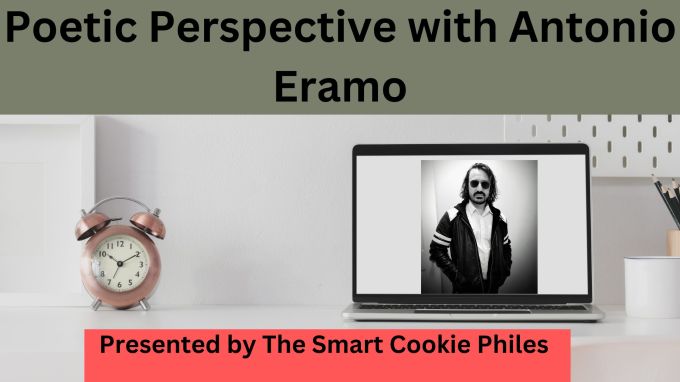
Today we have the privilege and honor of sitting down for virtual coffee with best-selling poet Antonio Eramo.
His book is in the Top 100 in all 3 Kindle Categories, and even in the Top 20 in 2 categories with more than 168 reviews.
My review of his book is available on Instagram here.
What was your purpose behind writing Cicadas Serenade
Cicadas Serenade was written to be my own version of “song of myself” (Thoreau). My song, like the song of the Cicada, is loud and can be perceived as annoying…but it is nonetheless natural and beautiful in its own right. As far as purpose goes…well, it serves the same purpose as any song within nature, it means everything and nothing at the same time.
2. What’s your favorite thing about nature?
My favorite thing about nature is that it almost mocks man in its perfection. Every lesson I have ever learned I can see expressed in nature…and there is a great irony that we can only see the wisdom of nature after our own failures.
3. What do you hope people gain from Cicadas Serenade?
I hope to gain several things from this book. The number 1 thing would be understanding. Although the manner I express myself isn’t straightforward, I hope that those close to me can read between the lines and understand the overarching meanings. The number 2 thing I hope to gain is a bit of traction within the poetry community. The poetry community is oversaturated and it is very difficult to stand out or be heard. I am hoping that this book can help usher in a return to form for poetry. Most modern poetry is full of bromides and bad line breaks, and I think the reader deserves a bit more than surface level thoughts masquerading as a poem (insta-poetry).
4. As a poet and a writer, where do you see your career going next?
As a poet, I see myself slowly climbing the ranks on amazon and establishing my work as an indie publisher. I am adamantly against big name publishers, so I do not see myself submitting to any of them anytime soon. I do not foresee myself ever being able to live off my work as a poet, which is definitely a blessing in disguise…I feel that if you treat art like a job/career then the work suffers
5. Any new books currently in the works?
I have a new book out called “The Day Prior” which features AI artwork. Most people have been using AI to create art…but I was more curious as to how ai interprets art. I plugged each poem in as the input and had an ai generator interpret the poetry and create a corresponding image. The point of the collection is to analyze the process of interpreting art. In general we have a major issue with something I like to call the “coerced consensus”…in school we interpret things as we are told to interpret them…likewise, ai can only interpret things based on its algorithm (how it is told to interpret). I am curious to see if the images impact the readers ability to interpret the poetry and if it influences their perceptions before they even read.
6. Who are some of your favorite poets?
T.S. Eliot and Robert Frost
7. Who inspired you to become a poet or was there a pivotal moment that made you become a poet?
I don’t really remember what kicked off my fascination with words, but I do recall that it was a sudden snap. One day I just started writing poems.
8. Anything else you want to share with my readers about poetry or your writing career?
A bit of advice for anyone new to poetry…learn the forms and learn poetic devices before embarking on the journey. After you learn the rules you can break them…but for the love of god, learn them first.
Today, we have the honor and privilege of sitting down for virtual coffee with Matthew Gutierrez, author of Notes I Wrote Along The Way. A review of it can be found here.
What was the exact moment you decided to begin writing Notes I Wrote Along The Way? I had been writing for years before 2019, so I had quite the collection, but in 2019 it dawned upon me that I should release them into the world so others may enjoy them and not keep them locked in my computer.
One of my favorites from the collection is Universal Control? Can you tell us more about the backstory behind the piece?
This poem speaks about the complete control that the universe has over all living things; the universe maintains complete control, and we are subject to the twist and turns that are thrown our way. I believe that our existence is part of the universe’s plan and we must all play a part and complete a purpose to that plan.
Besides poetry, what else have you written? I have written screenplays, short stories and currently I am working on more poetry and a longer fiction piece that will become a novel.
Do you plan to write another poetry collection? If so, do you know what the themes may be? I am currently working on writing more poetry and editing and rewriting pieces that I already have picked out for my next collection. I want the next book to be more personal, more direct about pieces of my life and things that have happened in my life. The themes will remain the same as the first collection, I like to focus on the universe, a higher power, love, life and death.
Who inspires you most in your life? I inspire myself… my life inspires me and the people that come In and out of my life inspire me in some manner. Life is full or inspiration and sparks ideas to write.
Who are some of your favorite poets? I would say that I am a fan of Pablo Neruda, John Keats, Langston Hughes, Sylvia Plath, Phillip B. Williams, Roger Reeves.
7.What’s your favorite thing about poetry? I love poetry because you can find the right words for a poem that you cannot seem to discover when speaking to another human being. I started writing poetry due to the lack of courage I had to say a few things on my mind. I found it easier to write them as poems instead.
What is most misunderstood about poetry in your opinion?
The state of being abstract. I hear often, in my MFA program, that I can be a bit too abstract, and I need to be more grounded and concrete when writing a poem. While I am working on being more focused on describing a scene, I do believe that I am that poet and have to stay true to what I do.
Author of ‘Sticks & Stones’ Interviewed on Podcast Themed Around Resilience
Chou Hallegra, mental health consultant and owner of grace & hope consulting, recently interviewed Chelsea DeVries on The Grace & Hope Consulting Podcast. The 17 minute episode is focused on DeVries’s experience working in a toxic workplace and how it impacted her mental health but yet she found the strength to overcome from that experience by writing and compiling her poetry collection Sticks and Stones: Full Story Edition. This episode is available here or on Apple Podcasts, Spotify, and Google Podcasts.
About The Podcast: This podcast is an outreach marketing effort expanded on Grace & Hope Consulting, LLC is a person-centered and community-focused company providing mental health, personal development, and inclusion supports to individuals, families, organizations, churches, and communities. Through con
sulting, counseling, coaching, training, writing, and publishing, we help individuals achieve mental and emotional wellness, reach their full potential, and live fulfilling lives. We are committed to promoting social-emotional learning, human potential, diversity, inclusion and belonging. Find out more at www.graceandhopeconsulting.com
About the Author: Chelsea DeVries wanted to be a writer at the age of 7. Her first publishing credit came at the age of 14 with a poem in a student anthology. She then wrote nonstop while doing IB classes in high school. She published two YA novels while still in high school which after over 10 years she rewrote as a NA romance that she looks to put out as her next publication. She is a seeker of justice and uses her words to free this world’s outcasted, peculiar, and underdogs from the chains that bind them. When not writing she runs and does PR for authors and musicians with her bookish brand The Smart Cookie Philes. Though she’s Florida born and raised, she has New Jersey in her veins. She currently lives in Port Richey, FL with her squad of two dogs.You can follow her on Instagram and Facebook at @onegirlrevolution26_, and her squad at @dasquad26. In October 2020, DeVries was diagnosed with Asperger’s Syndrome which is a form of Autism.
Today, my guest of this new series is Molly S. Hillery Best-Selling Author of Bare Roots and Recently Released Follow-up collection The Medicine That Burns.
The Smart Cookie: Molly, Thank you for joining me today. Any writer would definitely agree that the act and art of writing is in itself very cathartic. What was the moment you realized you should write poetry to share your story?
Molly: That’s a great question! I have always wanted to become an author and I always loved journaling and writing as a child. After what I went through in my teen years, I really felt like sharing my perspective. I didn’t write for fame or fortune, it was just special to me to be able to share my story and fulfill my dream of publishing.
The Smart Cookie: You write about real human struggles related to trauma and mental illness. What inspires your ideas for poems?
Molly: All of my poems come from my own experience and perspective. A lot of the poems I wrote in bare roots were inspired by blogs I had published in early 2015, that I fit together into a cohesive narrative. Many of the poems in The Medicine That Burns were written in first-person perspective from journals and many were written following therapy sessions.
The Smart Cookie: Outside of poetry, would you ever consider writing a memoir to share your full story?
Molly: I think in their own way, both of my collections are a memoir. They are just more stylized and easier to digest, in my opinion. Readers who have read both books will have a pretty solid idea on what I have been through throughout my life!
The Smart Cookie: I think in their own way, both of my collections are a memoir. They are just more stylized and easier to digest, in my opinion. Readers who have read both books will have a pretty solid idea on what I have been through throughout my life!
Molly: On the good days, I feel creative and enjoy writing and being artistic, like painting and collaging. I love to just relax and unwind after a full workday, so the normal Netflix, snuggling with my dog, and talking to friends on the internet works for me! I also spend a lot of time with my family these days, which has been a nice change of pace. My nephew will be three this summer!
The Smart Cookie: Bare Roots and your upcoming release Medicine That Burns share similar truths about the after effects of trauma and traumatic experiences but Bare Roots uses a resilient view while Medicine that Burns is darker, raw, and emotive. What was the writing process like for each book, and which one to you felt like more of a release than anything?
Molly: The writing processes for both books were very, very different. I wrote, edited, and published bare roots in four months. I worked on it almost addictively; my husband and I were going through a rough time and I almost used writing the book as a safe haven/escape. My perspective on life really changed after my divorce; Four years passed between the two books and I lived a lot of life in between then. I started writing The Medicine That Burns in quarantine last year when I was on furlough from work. This process was a lot slower, and I took my time with it.
The Smart Cookie: What are your final words to those who are broken and bruised, and resonate with your poetry?
Molly: It sounds cliche but, that you are not alone, and that there is hope. I also really encourage people with trauma to continue to seek out appropriate treatment, because seeking the wrong kind of care can make things worse. At the end of The Medicine That Burns, I share some modalities of therapy that have helped me– I even had a medical procedure done to aid in symptoms. I want to share these with people in hopes that they can find relief in some of their symptoms, too. Trauma informed care is essential to recovery.
To find out more about Molly and her poetry, visit mollyhillery.com
Today, we are bringing you an exclusive author interview with debut children’s book author, Oscar Redden IV.
The Smart Cookie : What made you want to become a writer?
Oscar: Writing poetry was a way to express my thoughts and feelings in a constructive manner. At the time I was extremely shy. I was not the “social butterfly” in high school or college. I needed an outlet. Additionally, writing helped me understand and discover my voice. It was the only time I did not care about breaking a few grammar rules—delivering the unvarnished truth about life.
The Smart Cookie: How have your life experiences contributed to the creation of a character such as Albert The Albatross?
Oscar: I believe the exceptional home-training my parents instilled in my childhood was crucial in the creation of the character of Albert the Albatross. Lessons such as “treat others fairly, standing for a purpose, leading with integrity, sharing, being a team player and etc” all fueled the character. Many of the challenges that arose I had experienced or watched others endure. Throughout my life experiences, I was able to apply these teaching moments to become wiser, all while managing my emotions and projecting an effective attitude.
The Smart Cookie: What made you want to transition from writer to author?
Oscar: I consider myself to be an entrepreneur; I like to “dip and dabble” in different areas. I was not privy to authorship prior to my initial picture book. I looked at the transition as a short-term goal for 2019. Again, I do not have formal training or background in writing.
I took a chance on a message that I think resonates in society and will ultimately define everyone: how did we treat others, and did we live a life of pride that we would be comfortable telling our parents about?
The Smart Cookie: If you could chat with one person living or dead, who would it be and why?
Oscar: I would love to chat with my beloved grandfather, Oscar Redden JR, who recently passed away suddenly. He was my role model and gave me my very first job. Working alongside him, I witnessed his ambition, service to his community and love for family which left an everlasting impression on my life. I dedicated my book to him in memory of his life.
The Smart Cookie: In the book, Albert travels around and meets many people. Name a place you traveled to that changed you for the better. Talk about the experience.
Oscar: Approximately 4 years ago, I traveled to Costa Rica on a mission trip. The country was beautiful and solely driven by agricultural. Costa Rica contains over 100 volcanoes, positioned throughout the land. Uniquely, when the volcanoes erupt, the molten lava rolls down from the highest peak and saturates the land with minerals- spurring vegetation growth. Because the minerals in the lava are so rich, there is no need for farmers to do crop rotation, making farming easier and prosperous. When crops are harvested, they are sold as exports into America helping Costa Rica’s economy.
During my mission trip to Costa Rica I had the honor of serving at a non-for-profit recreation center for the youth. There I assisted with the sanding and painting of walls and helped with the mentoring of kids. This center was located right outside the capital, San Jose, in a small village called La Carpio (or the Village of Hope). I learned this village’s population is mostly children. Most of the kids attend school for half the day while the reminder work jobs to help support their families. Because children start working at an early age, education becomes less of a priority. I learned that the kids in this village do not have the opportunities to attend college. This was an “eye opener” for me as often we take access to education for granted in the United States.
Also, I visited another town called La Fortuna located right outside the capital. There I volunteered at an adoption shelter doing yard work- digging, planting and removing weeds from the garden. Also, I played board games with kids and colored with them. The kids seemed to really enjoy our company. However, it was heartbreaking to see them start to cry once we started to leave; their smiles faded. There were children asking us to adopt them. They sensed that no one was coming to pick them up. Unfortunately, our departure meant that they would have to deal with this harsh reality.
The Smart Cookie: What is the most important thing you have learned about attitude?
Oscar: A positive attitude can be contagious. Once you spread it, everyone gets a piece. That’s why I believe positivity is the catalyst to achieving altitude in attitude!
The Smart Cookie: Did you always want to write for children? Why or why not?
Oscar: To be honest, my intention was never to write for children. However, I saw an opportunity and took on the assignment. There are millions of kids across the world growing up without hope and aspirations. I wanted to create a picture book that had some substance and taught valuable life lessons to impressionable, young readers.
The Smart Cookie: When not writing, what do you like to do in your free time?
Oscar: I like to exercise. Also, I enjoy listening to old school R&B and hip-hop. I enjoy attending sporting events such as basketball games. Most of all, I enjoy spending quality time at home with my fiancé tending to our flower garden.
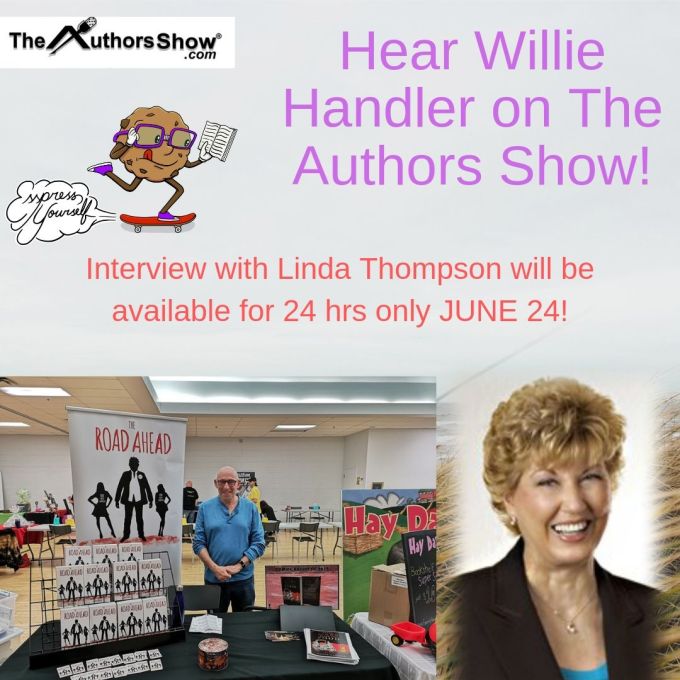
June 24, 2019 —– Canadian author of political satire The Road Ahead and forthcoming science fiction Loved Mars, Hated The Food (Kyanite Publishing, August 13, 2019) Willie Handler did an interview with Linda Thompson of The Author Show Podcast.
The interview primarily covers Handler’s first novel The Road Ahead and will only be up on the site and various other media platforms for 24 hours today only.
To listen to the inteview, please click the image below.








 The Smart Cookie Philes