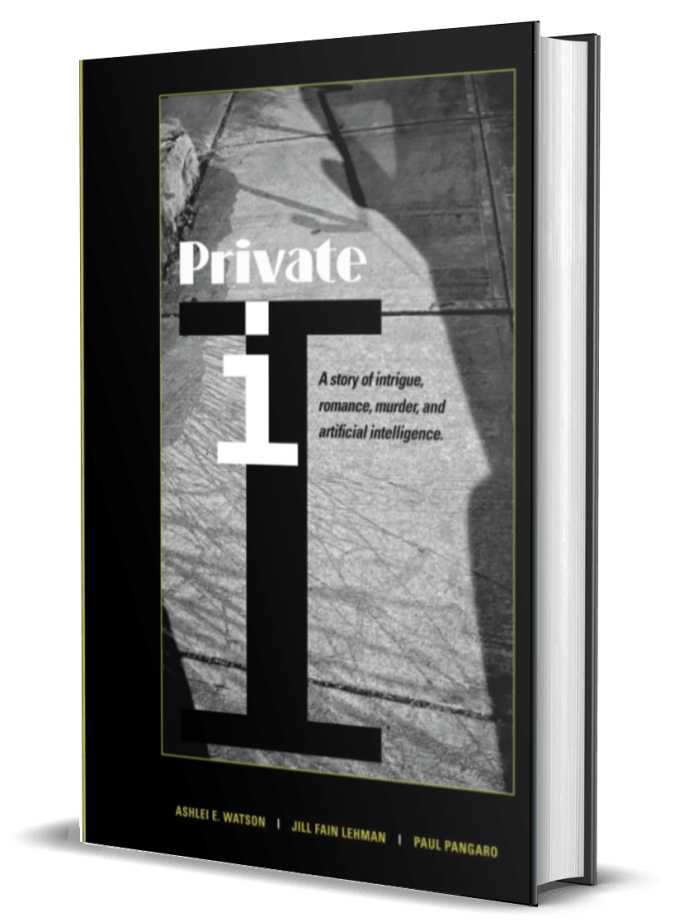
“Private I” is a gripping new adult thriller that weaves together elements of intrigue, romance, murder, and artificial intelligence. The story follows Paloma, a young woman on the brink of starting her college journey in Machine Intelligence (MI) at MITI, hoping to build upon her grandfather’s secret technological innovations. Her plans are violently derailed when she returns home to find her grandfather tortured and killed, with evidence suggesting his murderers were after Marlowe, Paloma’s MI companion of 15 years.
Forced to go on the run, Paloma must navigate a complex web of potential threats – from tech corporations to government agents to anti-tech terrorists – while protecting both herself and Marlowe. The novel explores contemporary questions about machine consciousness, human-AI relationships, and the societal implications of advanced artificial intelligence through a noir-inspired lens. What sets “Private I” apart is its unique dual narrative, featuring the internal monologue of both Paloma and her AI companion, offering a fresh perspective on classic noir themes while addressing today’s headlines about AI development and its impact on society. In a world where AI is no longer just a buzzword but a reality that has reshaped every aspect of society, “Private I” explores the very real implications of machine intelligence on human trust, relationships, and accountability. The novel is an unflinching look at how we navigate a future where the lines between human and machine are increasingly blurred. For fans of speculative fiction and sci-fi thrillers, “Private I” offers a gripping narrative that combines edge-of-your-seat mystery with profound philosophical questions about AI and humanity. It will appeal to readers who enjoy complex, thought-provoking stories like those of Philip K. Dick, William Gibson, and other tech-noir pioneers. Tech enthusiasts will be excited by a new take on AI’s evolution and its implications for personal relationships, while lovers of psychological thrillers will appreciate the tensions among human characters in a world fractured by its willingness to be dominated by intelligent machines. “Private I” will resonate with readers who are fascinated by AI, technology’s role in society, and the ethical quandaries that will soon be upon us all. It’s a compelling blend of mystery, noir, and thriller, all wrapped in a deeply human story about love, betrayal, and survival. If you’ve ever wondered what happens when machines think like humans and humans have to trust machines with their lives…this book is for you.
“Private I” is available on Amazon. The authors are grateful for any reviews you can share on Goodreads and other social media platforms!
Ashlei E. Watson is an American novelist, known for her work that blends speculative fiction with deep philosophical themes.Jill Fain Lehman, PhD, is a Senior Project Scientist at Carnegie Mellon University’s Human-Computer Interaction Institute with over 40 years of experience in artificial intelligence, natural language processing, and machine learning. She has collaborated with leading organizations like Disney Research, The Rand Corporation, and Carnegie Learning. Jill is the co-author of Private I, a speculative fiction novel exploring the complexities of AI, consciousness, and trust.Paul Pangaro, PhD, is an entrepreneur, researcher, and educator with over 30 years of experience applying cybernetics to human-machine systems. He has founded multiple startups and now teaches at Carnegie Mellon University, where he is establishing a Laboratory for Cybernetics.
No, this is my second novel and fourth book. Journey to 2125 was released on September 30th.
Let me describe this book in the context of my first novel, and the entire project surrounding AI and robotics that the two novels together explore. My first novel, Unfettered Journey, attempted to realistically imagine the world of 2161. By then, I guessed that – at long last, though science fiction writers have already been imagining it for a century – robots would be walking among us and doing many of our jobs. The central question was: could those AIs embodied in robots attain consciousness? My studies in philosophy of mind encouraged that question, and I explored it in the form of a novel, with characters with whom the reader could feel an empathetic connection.
I thought that was my only novel. But fans were taken by that highly realistic world, and asked, “How did we get there?” That question, and the rapid development of AIs caused me to consider a second novel. I was driven to it when I realized that multiple problems were on humanity’s doorstep this century, and fiction writers did not appear to be helping to focus attention on them.
That is the impetus for my latest book, Journey to 2125. It tells a story of this next century, told through the lives of a family, of how they meet the challenges brought on by accelerating technological change. The story focuses on a grandfather, Max MacGyver, and his long-separated grandson, as Max reveals the family secrets and tells their story.
2. What do you hope people gain from Journey to 2125?
That is best answered by the epigraph in my novel, Journey to 2125. Which is:
Of the many challenges ahead this century,
a few matter.
Focus on and overcome those few,
and you, yours, and the world
will survive, and perhaps even thrive.
Facing accelerating change this century, humankind needs to be strategic, to focus on the most pressing problems. I give my list of those key problems in the novel. My readers can watch my characters respond to the world and these problems, that I really believe we will see coming to fruition. We need to stop talking about them endlessly, and instead we need to solve them.
3. What role does technology play in politics?
Technology will continue to play a role by changing the playing field in how candidates get elected. For example, FDR used the new technology of radio in his day. Kennedy mastered the television debate, arguably for the win in 1960. Social media has played an enormous role in the last three presidential races, for good and evil. In Journey to 2125, I describe the use of “digital twins” being used to sway an election. Technology and its impact, especially on the survival of democracy, must be carefully considered. That is one lesson of the novel.
4. What do you like to do when not writing?
My wife and I love to travel, having visited over 130 countries. Most recently we spent October in the Caucasus, and were in Georgia when the elections were underway. Sadly, the pro-Russian forces stole the election, and now the country is turning away from the EU. We travel to better understand the world, in all its complexity. I sit on two nonprofit boards, for the Exploratorium of San Francisco, and for the Santa Fe Institute, focused on complexity studies and cross-disciplinary research. I have an observatory in the Sierra Nevada foothills, where we run astronomy field trips for high school students. And I enjoy making a nice Cabernet wine at our vineyard in Napa, where I also raise bees.
5. Do you trust AI?
“Trust” is an interesting word to use, suggesting something human-like, with human-style consciousness. From my philosophical training, I think machine consciousness will not appear anytime soon. But well before that, we need to worry about the loss of jobs and that impact on our economic society.
The question is perhaps seen in the context of those who are worried that AGI – artificial general intelligence – would be achieved very soon in AIs, and then the machines would be able to replace us. The replacement image conjured is of some Terminator-like invention.
Two years ago, we had the “chatGPT moment” when the technology demonstrated a dramatic leap. Roughly one hundred billion dollars has since flowed into AI companies. It is clear that the technology will dramatically change many jobs and replace many people. My expectation is that over the next two decades jobs will be redefined, many will disappear, and many new jobs will be created.
We will also learn the limitations of the AIs. The AIs will make mistakes. Some mistakes will be costly in human injury and money. I doubt that very many sectors of the economy will operate with AIs who have no human oversight. And I do not expect any Terminator to walk down the street any time soon.
Notwithstanding the astonishing capabilities of AI technology, I suspect we will see the limits showing soon. I follow long-time AI researcher Melanie Mitchell at the Santa Fe Institute, and her questioning of the current exuberance. We need be cautious about the AI hype.
That is the shorter-term picture. How long will it take for “true” artificial general intelligence? That depends upon one’s definition of AGI. I suspect that some AGI definitions leave too many loopholes to allow a claim that AGI has been reached. But what do we really fear? I cover that topic in my book, Journey to 2125, with a careful definition in the glossary.
Two primary human fears surround the attainment of AGI by a machine. First is the fear that achieving “strong AGI” leads to the replacement of humans and, at a minimum, the need to address moral and ethical responsibilities to AGIs as fellow sentient or conscious creations. Second is the fear that AGIs will replace most human jobs.
Regarding the second fear, perhaps a useful working definition would be that a practical economic AGI is a computer AI, deployed with ecological validity in economic settings that is recognized as consistently performing, un-aided by any human, a reasonably complete set of capabilities superior to those possessed by an intelligent 25-year-old educated person. Capabilities include the ability to learn and adapt goals in a dynamic environment.
The definition of practical economic AGI focuses on the fear of human economic displacement. I think that the tsunami of job losses to AIs will not occur until robots have been sufficiently refined, made cheap enough, and capable enough to walk among us. Then they will transform the economic system. That second wave, which I do not foresee until the latter half of this century, is a central theme of Journey to 2125.
What about attainment of “strong AGI,” when AIs (certainly embodied in robots) might begin to reach sentience, or even some sort of consciousness? My studies in theory of mind (from my MA in philosophy) suggest that will not occur until the next century at the earliest, and perhaps more likely much farther in the future. The “hard problem of consciousness” (a term coined by David Chalmers in 1995) is indeed very hard. That’s the subject of my first novel, Unfettered Journey. Both novels attempt to make this complex technology more understandable, more concrete when described in the form of story, with a realistic, hard-science approach.
Gary F. Bengier is a writer, philosopher, and technologist with a deep interest in how technology and human experience intersect. After a notable career in Silicon Valley, including his role as eBay’s Chief Financial Officer, Bengier pursued his passion for astrophysics and philosophy. His previous work, “Unfettered Journey,” earned acclaim for its philosophical depth and realistic world-building. His latest book, “Journey to 2125” is hailed as a visionary masterpiece that blends compelling storytelling with thought-provoking insights on climate change, technological advancement, and the future of humanity. Through a richly crafted family saga, Bengier paints a vivid picture of our potential futures, challenging readers to reflect on their role in shaping a sustainable and harmonious world.
I was given an advanced reader’s copy in exchange for an honest review.
Opening with the phrase:
the reader is instantly taken on a journey with the perfect mix of romance, science fiction, adventure, and a philosophical curiosity of free will and the existence of God.
Bengier’s writing is futuristic yet relatable with it’s discussions of protests and social equality, and very captivating.
For more on the book and the author who created this metaphysical world, check out https://garyfbengier.com/
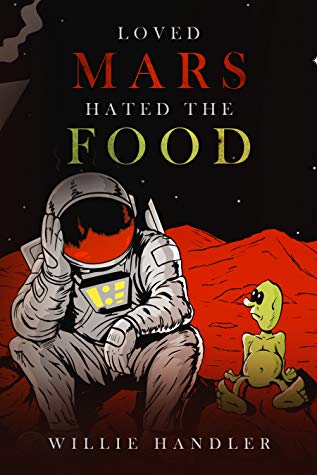
Willie Handler is no stranger to writing books that make you laugh but the second novel from this author is nothing less than an out of this world story that will have you shaking the cosmic dust off your space boots.
Dixon Jenner is a thirty two year old chef who gets recruited by NASA in the year 2039 for a Mars mission that goes terribly wrong to his spaceship explodes and he is the only sole survivor.
Right away, he is high from a marijuana infused brownie and he has to figure out what to do to survive post-explosion. He meets two martians Bleeker and Seepa and from there they hide him from the head martian Cheytno to avoid anyone finding out he is from Earth.
What ensues is a hilarious story that leaves space for countless belly laughs over martians learning more about earth-like customs from an American chef from Toms River, New Jersey.
I was hysterically laughing by page three and I could not find a good reason to put the book down.
Handler’s science fiction is informative, clever, and loaded with quick-witted funny scenarios and one-liners.
It’s definitely a book with a brilliance not yet experienced on this planet but no matter who you are, human or martian, Handler’s writing will keep you hooked from start to finish.
A Chef Stuck On Mars is Not the Funniest Thing You’ll Find in Loved Mars, Hated The Food by Willie Handler
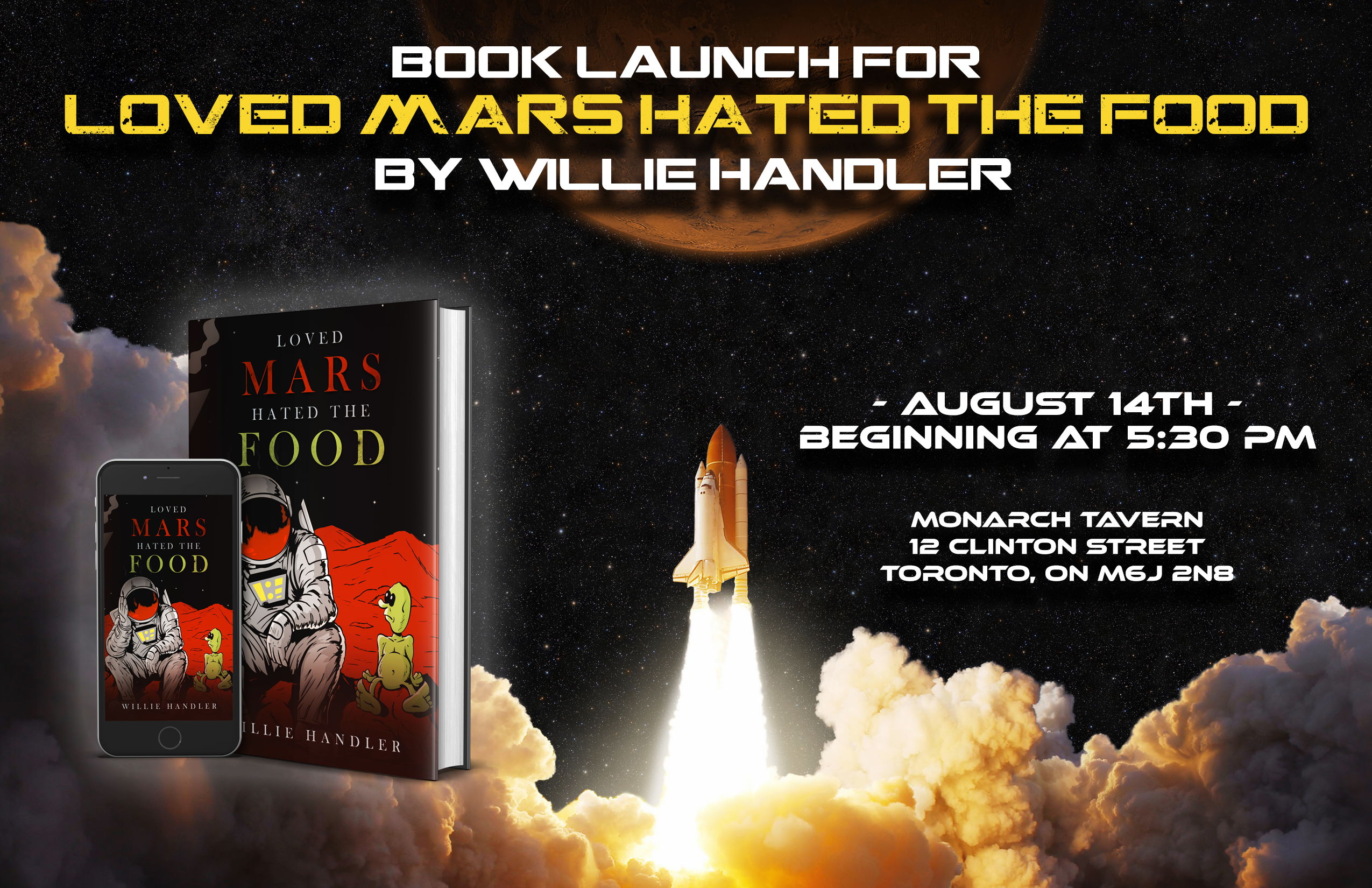
Kyanite Publishing Author is available for interviews and events as well as blog tours. Willie Handler is back with his second novel, his irreverent and hilarious science fiction debut about a thirty-two year old chef Dix Jenner who is selected for a mission to Mars by NASA. The book is abound with subtle satire that provides the story with depth. The novel will be released on August 13 and is already available for pre-order via Kyanite’s site.Loved Mars, Hated The Food already has many five star reviews as well as an endorsement from fellow Canadian author and two-time Leacock Award winner, Terry Fallis . Handler is holding a book launch event in his hometown of Torono at the Monarch Tavern on August 14 at 5:30 p.m.
About Loved Mars, Hated The Food:
Dix Jenner, a self-proclaimed slacker, is the first chef to live—and maybe die—on Mars. After an explosion kills his colony companions and leaves him with nothing but his spacesuit, his time on the faraway planet is about to expire… until he’s rescued by friendly Martians Bleeker and Seepa, who smuggle him into their vast underground civilization.
Despite an unfamiliar world of telepathy, strange class dynamics, and really bad food, Dix sets out to make his mark. After opening a cafe—who knew Martians loved espresso?—he starts to notice that responsibility can feel good. Not only that, but he’s got a new romance, and for the first time he actually cares.
Unfortunately, his success attracts the attention of the corrupt and narcissistic Martian Grand Leader. Forced to run to avoid being imprisoned, Dix gets lucky: a NASA rescue mission lands on Mars. But seeing it brings back the dark secret he’s been keeping from himself about the colony’s explosion, and now Dix must choose between returning to Earth or spending the rest of his life in a cell on the dusty red planet where he belongs.
About The Author:
Author Willie Handler was a satirist well before he became a novelist. Hailing from Canada, where self-deprecating humor is part of the national character, he finds targets for his humor everywhere. His targets include friends, family, co-workers, politicians, farmers, subway passengers, bureaucrats, telemarketers, Martians, and his barber, Vince. In 2016, he released his first novel THE ROAD AHEAD. With his most recent work, he has crossed over to the world of speculative fiction.
To schedule an interview with the author or to schedule him for a public appearance, please contact his publicist Chelsea DeVries at smartcookiepr26@gmail.com
To pre-order Loved Mars, Hated The Food, visit this link.
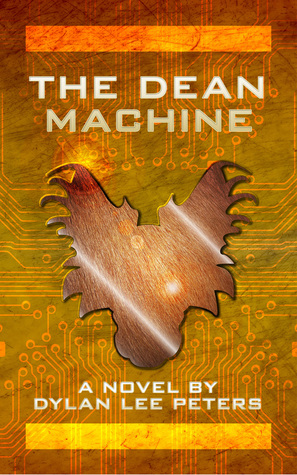
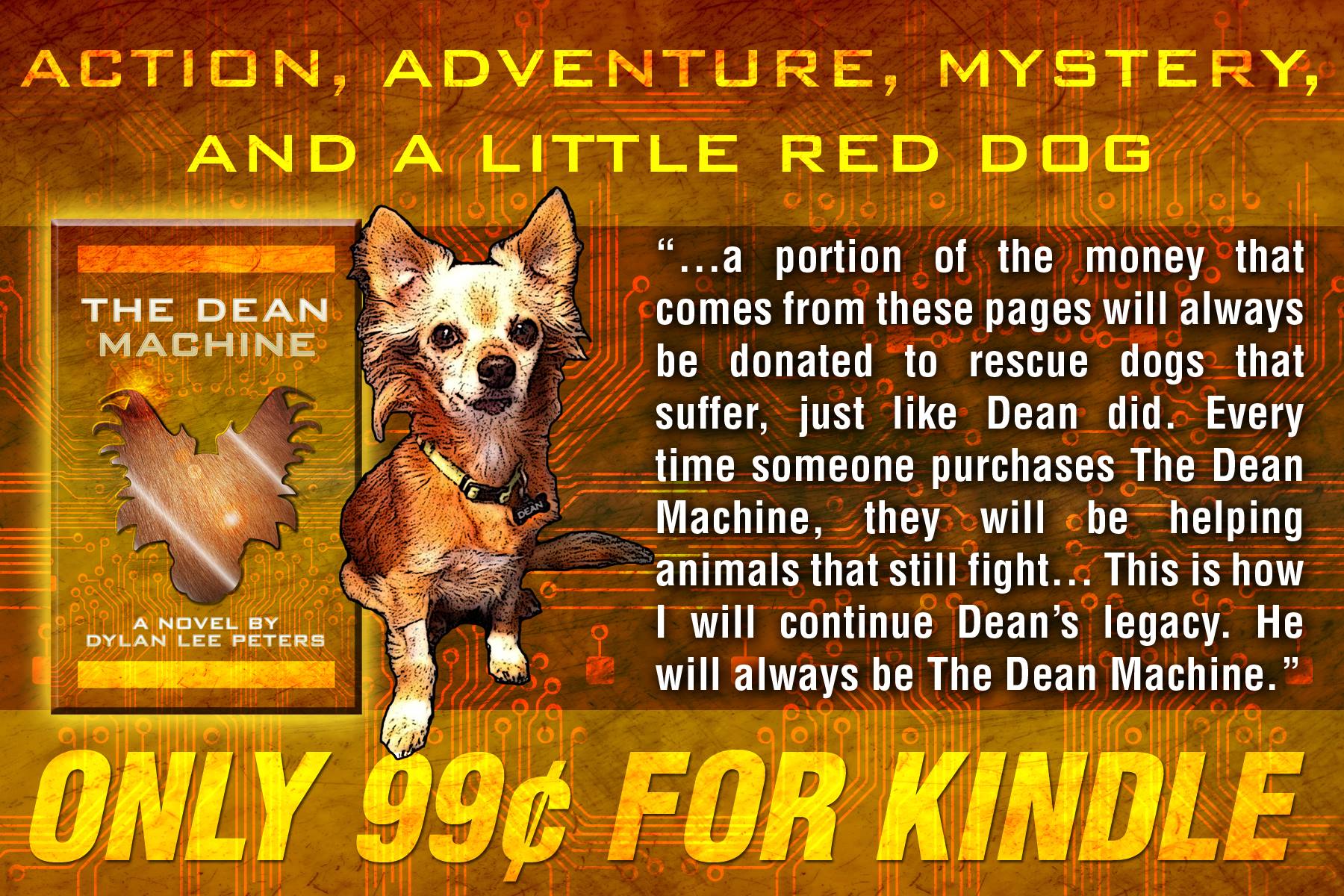
Growing up one of my favorite books and a staple in my childhood was The Giver. Then, for some reason, I basically forgot how much I loved science fiction in order to pursue YA fiction, etc. Then, I started reading this book and wow, what a READ! From the first page, I was hooked. Why? Well, let me tell you that the main character of this novel isn’t Dan Delacor but his dog, Dean.
Written in memory of the author’s own dog Dean, there was a part in the beginning of the novel that literally encapsulated all that I miss about my own soulmate and best friend Geniveve who left to visit the rainbow bridge in the end of July 2015. I definitely teared up. I love the dystopian futuristic feel this novel has and everything about it worked smoothly and efficiently like any machine might.
This book itself is a machine with a heart that beats perfectly in sync with those that choose to read it. Some may call it a “heart bond” made just for you.
To keep up with Dylan Lee Peters other works and works in progress, please visit his Twitter and his site.
To keep the machine that is this site running, I’m holding another giveaway!
Two winners will win copies of The Dean Machine straight from the author.




 Growing up one of my favorite books and a staple in my childhood was The Giver. Then, for some reason, I basically forgot how much I loved science fiction in order to pursue YA fiction, etc. Then, I started reading this book and wow, what a READ! From the first page, I was hooked. Why? Well, let me tell you that the main character of this novel isn’t Dan Delacor but his dog, Dean.
 The Smart Cookie Philes