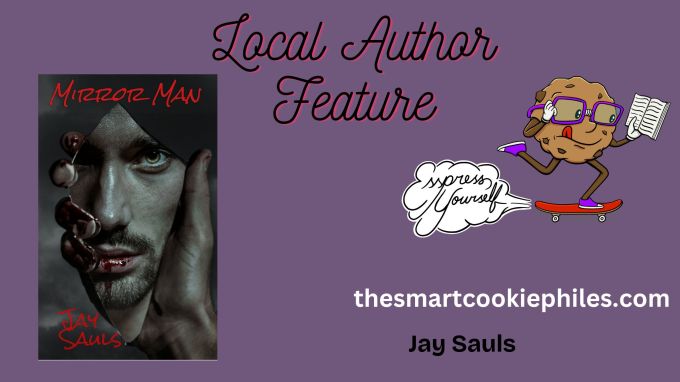
For those who don’t know, I recently met Jay at the Tarpon Springs Book Festival. I unfortunately did the six hour showcase without a tent (times are tough), and him and his wife lent me an umbrella for my mom and I to use to shade us from the sun.
Let me tell you about his book: Mirror Man by Jay Sauls
Set against the backdrop of southern swamps, and dirty cops, Mirror Man is an adventure into cardiac madness with more twist and turns than an Appalachian mountain backroad. Jonesy can only recall the last eight minutes of his life. Prior to that, nothing. Nada. Zip. His only memories are disjointed flashes of a prior existence. The glimpses run for a few seconds before melting away like burning film in an old 8mm projector. His last solid memory of any length is that of him being violently thrown from a speeding vehicle and left for dead. He has no idea where he is, who he is or why a pack of killers are chasing after him, attempting to put a bullet in his head. All he knows for sure is that the severed finger he found in an empty cigarette pack will perfectly match the body lying at his feet. And with no memory of his past, or knowledge as to why a pack of furious men are trying their damnedest to kill him, Jonesy must rely on raw animal instinct and his untested wits to stay alive for another 24 hours. If he can.
You can check out this and many other books by Jay on Amazon.
This post appears as a FREE promotional offer. To hire the Smart Cookie for your book and music publicity needs, consider contacting me here. To buy me a coffee visit here.
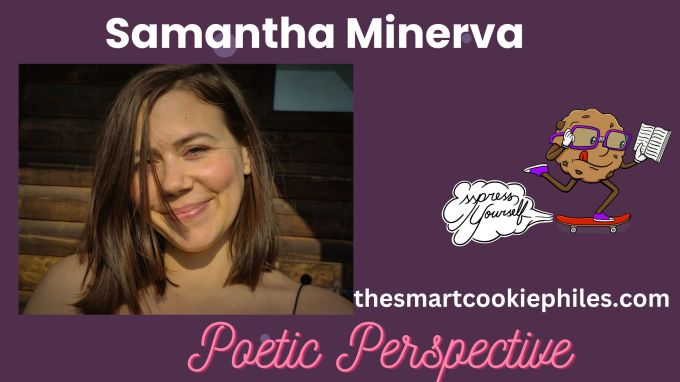
I didn’t choose poetry. When I put pen to paper, poetry is just what happens. I wrote my first poems when I was 13, but they were dark and my mom read them from my diary. I was so angry and ashamed I never wrote again until these books poured out of me at 31.
2. Tell Me About Your Most Recent Collection.
2. My most recent collection is a culmination and explosion of all of the feelings and expressions I had stuffed down my whole life. I hit a wall in my life and needed an outlet. I did not write with any intention of publishing whatsoever until book 3. Books 1 and 2 were written together within just a couple of weeks.
3. Give the backstory behind one of your poems
The first poem in book 1 was a profound experience for me. It was the day I finally let myself write again after all of those years and the way it flowed out of me felt like it wasn’t even me writing. This is the case for all of my poems. It feels like a channeling experience when I write, like a perfect mixture of my creative and logical sides creating magic together.
4. Who are three poets you always recommend?
Ironically, I actually don’t read or enjoy poetry very much. Never have!
5. I am currently reading…
I am currently reading a lot of kids books, as a mom to two little girls 🙂 My personal genre is mostly metaphysical, esoteric, psychology, etc.
Look for a review of Samantha’s collection coming soon to our Instagram and Facebook pages.
Every year in honor of National Poetry Month, I offer FREE review and feature for independent and traditionally published poets. This is a FREE feature to celebrate the power and brilliance that is poetry and those that create it. To hire me for contracted marketing and promotion for your music or books, contact me here to get started. To say thank you for this post, consider buying me a coffee.
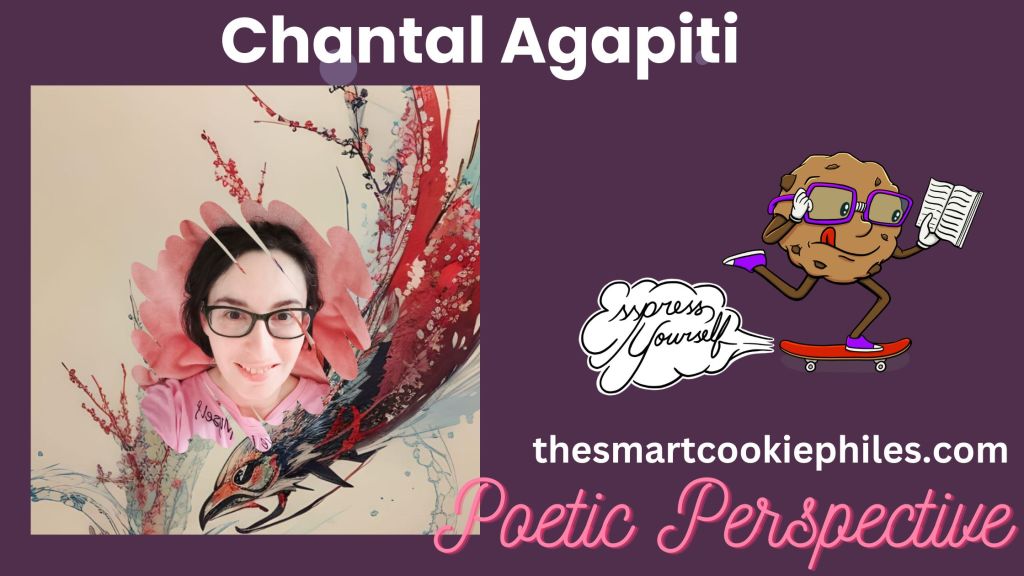
Poetry is such an untamed form of expression, it let’s you free as a writer to tackle any topic and let it sound artistical. Which makes talking about challenging issues easier, more approachable to the audience.
2. Tell us about your most recent collection.
My latest Poetry collection was published just a few months ago. It’s a thought instigating kind of poetry, because I’m a nonfiction author and I aim at letting people reflect about all that is life. The purpose is to get curious again, reflect and see things as if you were seeing them for the first time. That’s why I chose a provocative title Y.U.P. which you read as the letters of the alphabet, yet it makes you think about something that you do every day.
3. Give the backstory behind one of your poems
Many poems come from my own experience and lessons learned. And one of my favorite ones is “Sharing”, I want to let people see that keeping it all in makes it only worse and in the end it will drag you down. If you want to heal, start by sharing. You’re free to decide for yourself in what way you want to do it, I also advise journaling as an effective way to share your thoughts and feelings. It’s such an intimate form, and nobody has to know about it.
4. Who are 3 poets you always recommend?
I don’t have favorite poets, yet I do have inspiring quotes I refer to often and my favorite masters of philosophy are:
– Mother Theresa
– Bruce Lee
– Albert Einstein
5. I am currently reading….
Oh that’s a tough one because I’m a moodreader so that answer shifts according to when you’re asking.
I’ve begun reviewing on Netgalley again, and I have some books waiting for me on my shelf.
As a Nonfiction writer and reader, I always look for books which topics speak to me. It’s essential that I can relate to it, or learn from it. That’s one of the main reasons why I love reading, endless inspiration and forever learning.
Every year in honor of National Poetry Month, I offer FREE review and feature for independent and traditionally published poets. This is a FREE feature to celebrate the power and brilliance that is poetry and those that create it. To hire me for contracted marketing and promotion for your music or books, contact me here to get started. To say thank you for this post, consider buying me a coffee.
1. Why Poetry? Poetry has always made me feel challenged. When I was younger and I couldn’t express myself properly, or didn’t know how to put things into words, I would use descriptions. I’ve always loved symbolism and imagery and the ability to paint a picture with words. I have a tremendous love for art, for poetry not only helps me to feel challenged, but it also helps me to be able to express myself. And as I got older, it provided an outlet with the things I dealt with in life, things I felt like when I was alone, I couldn’t talk to anybody else about when I felt like no one else was there. I knew that I could have some kind of release in some way, because I always wanted to have good outlets. Poetry has always given me one that I felt would be not only a positive outlet for me, but an inspiration for others.
2. Tell us about your most recent collection.
So my most recent collection is called Renewal’s Virtue: Lover’s Paradox. It is a collection that is an anthology of the first three books that I’ve ever published, put together in the exact order, with the precise imagery that felt like an impossibility or struggle with the publisher I was with at the time. So the collection is incredibly intentional in every decision that I made with it, every single image in that book has some kind of imagery or connection to the poem with which it is attached. The book is a journey from where I went struggling with mental health and anxiety and personal things I conquered throughout my lifetime, to figuring out who I am, and soul searching and understanding what it’s like to come to a place of love, not only for myself, but with the ability to see the world through a completely different lens than which it starts at the beginning. It’s meant to be as immersive, blunt, and descriptive as possible, per my style, personally. And the collection is also meant to tell a story. The poems are meant to be pieces of a larger puzzle, that when you put it together, you get the entire story, the entire experience, and hopefully you take something from it too as the reader, it’s one that I put together again to inspire and to let others know that when they’re in that dark place. You know, there are people as much as we feel alone, and as much as hyper vigilance and anxiety will hold us back and tell us that we are alone, the truth is that we aren’t.
3. Give the backstory behind one of your poems:
Poltergeist was written at a time when I had just ended a five-year relationship with my ex-fiancé that ended in infidelity. I had not realized a lot of the triggers that were within me, but one of them, and one that was very deep seated fear and anxiety within me was a desire to be loved, but not only to be loved in general, but to believe myself worthy of love like basically an impossibility, to ask of another, of another human being, to love me to the extent where I could Learn to love myself and what the poem is about is kind of the aftermath of that, where I’m going out, I’m not making the best choices in terms of the people I’m adding to my life. And I felt like I was constantly rotting. People were constantly not hearing me, so they wanted to hear whatever they wanted when I spoke to them. But, you know, they couldn’t dare take a risk. It would, it would be evil for them to take a risk and show that they cared about me. I saw the world through a tremendous lens of hypervigilance. I believe people were fleeting and weak and unable to stand up to the strength that I had internally. That was how I was perceiving the world with all this heartbreak and these these triggers that it taught me that love was something to fear, and I felt incredibly warm and comfortable in that there’s a line in a book that I read growing up that said pain was an old friend, and that always stuck with me, because, in a way, those of us that get used to pain realize that it is a friend because of how it mirrors aspects of ourselves we can change and continually grow as people. You do develop a comfort level with it, and that’s one of the reasons that I love to delve into these topics as an artist. There are lines in the poem like covering up with a jacket to bring warmth to no soul. I’m very, very, very realistic and existential. We have a limited amount of time on this earth, and I want to make the most of it. When I was younger, one of the ways I didn’t think I could, quote, unquote, save myself. So I developed a savior complex, believing I could save the world and impact others, that I was going to make a difference, and that people would care if I wanted to make a difference in their lives. So a lot of promises were made to me and them that were broken. You know, vice versa. People gave up on me. People would push me away or tell me I wasn’t good enough. So I came to believe that the only promise that would ever be kept to me in the world is that the inevitability of life would one day cease and that it would all be over anyway. The poem further on is a larger point of me just falling further and further into this descent and under, and figuring out that the way that I see the world is what I’m creating. I created a poltergeist in the way that I looked at the world. I created a ghost that was made in a curse that I, you know, that I inflicted upon myself with these things, and in my heart, where I desired a home, I had instead defiled what mattered most. I had defiled my foundations and cursed myself into believing that I was going to be haunted for the rest of my life. And towards the end of the poem, it wraps up with a flower floating through the trees with undeniable grace, strumming a harp with the stars seeming, singing of space. And so I come to believe that I’m addicted to it, that things will never change. I won’t be able to establish that. For some reason, I have all the natural ability and power in the world to make any difference in anybody else’s lives except my own, and that feels like such a lost space to be in, to the point where I eventually felt like I was not heeding my warnings, and I was giving my heart away to others to eat on a silver platter. That’s why the final line says that crows devour the hearts of those who failed to heed the warnings of the gallows, because I got to a point where Emotionally, I had hung myself to an extent where I didn’t feel the heart of my chest anymore, and it took so much effort to bring that back within me. The way we perceive the world, whether that be driven by love, trauma, whatever it is, at our foundations, like at the end of the day, we do have to be the ones to look in the mirror and say, This is my reality, like this is my world that I’ve created. And I can either choose to sit here and continue to hand my heart out and not care that it’s getting stabbed every time, or I could take control and say that I do deserve better, and I need to make that happen for myself.
4. Who are 3 poets you always recommend? I always recommend Poe. He’s an absolute legend and an absolute tragedy of a human being. Many of my poems delve into the dichotomy of human beings and the darkness and light within ourselves, the things that we all deal with, whether it’s conflict, anxiety, joy, euphoria, love, those kinds of things. So I always like to recommend Poe, because he’s an incredible writer who lived an incredibly tragic life, Neil Hilborn. And I love, I love what Neil Hilborn is doing with button poetry, and his poem, OCD inspired me to get back to writing. I had taken a bit of a break for years, and I never really thought I was going to publish. This is before I published my first book, and I read, or I saw the video online of him reciting his OCD poem, and it hit me so hard. It hit me so hard to this day. It even hits me harder. Probably, I shed tears every time I see that thing. And I think that in modern times, it’s difficult to find actual poets who want to keep the art of it going, who want to keep the poetry and the metaphor and the storytelling and the, you know, the visuals and symbolism going, so I will always recommend him. I don’t know if I have a third that I could choose from. I could give you a lot here. I could give you Hemingway, Da Vinci, and ancient Roman poets. You know, there’s, there’s a lot that I could give you here. But I think that what I’d rather do, honestly, is bring attention to I would recommend any writer or any poet that takes it as an art form and takes it in a way to keep the writing alive. I would rather build awareness for their brand than the Instagram poets who have 100,000 followers, who their brand of poetry is a screenshot of a journal where they wrote the sentence of the last time I spoke to you was 10 pm and it’s morning now, and it’s in quotes, and that’s supposed to be a disgusting poem, and I would rather make my last recommendation one where I recommend to everybody that you encourage good writers, writers who want to put The time and effort into it. Instead of modern day, we go for clickbait writers who don’t have any talent and shouldn’t receive the promotion that others do. I do not care that That’s brilliant. That’s just the nature of that for me. Please support the writers. So I should want to keep this alive. Support kids who want to write. You know, when they go through ELA classes, do whatever you can to support this being a true art form, because my concern is that somebody who writes the way that I do, and with the level that I do, is that one day we won’t have this anymore. And I think it’s important to want to keep this alive for as long as we possibly can. So I want to give my last shout out to those people who have changed the world, and I would just recommend any poet that you see who has put a book together with some kind of intention, effort, and desire to create an art product.
5. I am currently reading…. I am not reading anything. I said that with laughter on my face. I am a full-time substitute teacher who is currently attending a four-year university to become a full-time teacher. So, between teaching kids all day, as well as doing schoolwork and doing everything else I want to do, like write, athletics, paint, Coach, you know, mentor, every other hobby that I have, I have not read anything in a while. The last thing I read was Meditations by Marcus Aurelius, which I would highly, highly recommend. I also love the shop. Genres I could give you, philosophy, action adventure, sci-fi, fantasy, and my biggest genres, I will always recommend them. Please read the old Star Wars books. I grew up on those. There are 300-plus that were not made by Disney. They’re all wonderful. There are so many series growing up. I could tell you one book in particular that I will recommend personally. It’s called Soldier Boys. It is by, I believe it’s Dean Coons, but I could be wrong. He’s one of two authors I always get mixed up because I read so many of them in the genre. And it is a wonderful tale of World War Two from the point of view of a Hitler use soldier who is trained to see the reality of the world and the openness of other people, and his name is Dietrich, and an American soldier who is trained in the same way, but they end up coming from opposite perspectives and ending up meeting each other on the battlefield at one point I will not spoil the story because it’s incredible, but I would highly highly recommend it would also recommend anything by Rick Riordan, whether it’s the Magnus game chronicles the obviously person, Jackson, the Heroes of Olympus series, literally, anything like that. One of my favorite books growing up was Dragon Rider by Cornelia Funke.
Every year in honor of National Poetry Month, I offer FREE review and feature for independent and traditionally published poets. This is a FREE feature to celebrate the power and brilliance that is poetry and those that create it. To hire me for contracted marketing and promotion for your music or books, contact me here to get started. To say thank you for this post, consider buying me a coffee.
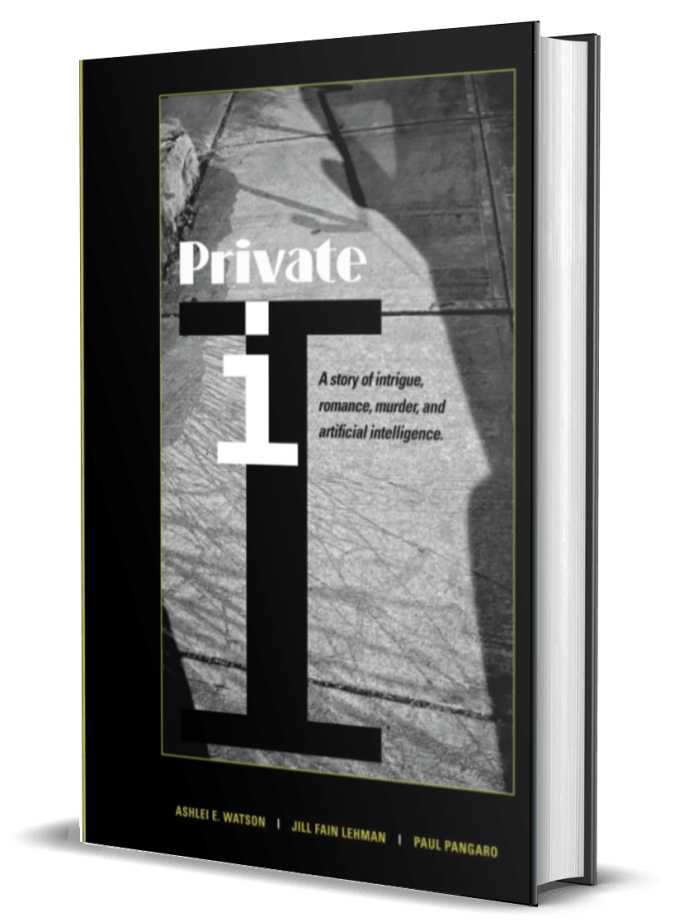
“Private I” is a gripping new adult thriller that weaves together elements of intrigue, romance, murder, and artificial intelligence. The story follows Paloma, a young woman on the brink of starting her college journey in Machine Intelligence (MI) at MITI, hoping to build upon her grandfather’s secret technological innovations. Her plans are violently derailed when she returns home to find her grandfather tortured and killed, with evidence suggesting his murderers were after Marlowe, Paloma’s MI companion of 15 years.
Forced to go on the run, Paloma must navigate a complex web of potential threats – from tech corporations to government agents to anti-tech terrorists – while protecting both herself and Marlowe. The novel explores contemporary questions about machine consciousness, human-AI relationships, and the societal implications of advanced artificial intelligence through a noir-inspired lens. What sets “Private I” apart is its unique dual narrative, featuring the internal monologue of both Paloma and her AI companion, offering a fresh perspective on classic noir themes while addressing today’s headlines about AI development and its impact on society. In a world where AI is no longer just a buzzword but a reality that has reshaped every aspect of society, “Private I” explores the very real implications of machine intelligence on human trust, relationships, and accountability. The novel is an unflinching look at how we navigate a future where the lines between human and machine are increasingly blurred. For fans of speculative fiction and sci-fi thrillers, “Private I” offers a gripping narrative that combines edge-of-your-seat mystery with profound philosophical questions about AI and humanity. It will appeal to readers who enjoy complex, thought-provoking stories like those of Philip K. Dick, William Gibson, and other tech-noir pioneers. Tech enthusiasts will be excited by a new take on AI’s evolution and its implications for personal relationships, while lovers of psychological thrillers will appreciate the tensions among human characters in a world fractured by its willingness to be dominated by intelligent machines. “Private I” will resonate with readers who are fascinated by AI, technology’s role in society, and the ethical quandaries that will soon be upon us all. It’s a compelling blend of mystery, noir, and thriller, all wrapped in a deeply human story about love, betrayal, and survival. If you’ve ever wondered what happens when machines think like humans and humans have to trust machines with their lives…this book is for you.
“Private I” is available on Amazon. The authors are grateful for any reviews you can share on Goodreads and other social media platforms!
Ashlei E. Watson is an American novelist, known for her work that blends speculative fiction with deep philosophical themes.Jill Fain Lehman, PhD, is a Senior Project Scientist at Carnegie Mellon University’s Human-Computer Interaction Institute with over 40 years of experience in artificial intelligence, natural language processing, and machine learning. She has collaborated with leading organizations like Disney Research, The Rand Corporation, and Carnegie Learning. Jill is the co-author of Private I, a speculative fiction novel exploring the complexities of AI, consciousness, and trust.Paul Pangaro, PhD, is an entrepreneur, researcher, and educator with over 30 years of experience applying cybernetics to human-machine systems. He has founded multiple startups and now teaches at Carnegie Mellon University, where he is establishing a Laboratory for Cybernetics.
No, this is my second novel and fourth book. Journey to 2125 was released on September 30th.
Let me describe this book in the context of my first novel, and the entire project surrounding AI and robotics that the two novels together explore. My first novel, Unfettered Journey, attempted to realistically imagine the world of 2161. By then, I guessed that – at long last, though science fiction writers have already been imagining it for a century – robots would be walking among us and doing many of our jobs. The central question was: could those AIs embodied in robots attain consciousness? My studies in philosophy of mind encouraged that question, and I explored it in the form of a novel, with characters with whom the reader could feel an empathetic connection.
I thought that was my only novel. But fans were taken by that highly realistic world, and asked, “How did we get there?” That question, and the rapid development of AIs caused me to consider a second novel. I was driven to it when I realized that multiple problems were on humanity’s doorstep this century, and fiction writers did not appear to be helping to focus attention on them.
That is the impetus for my latest book, Journey to 2125. It tells a story of this next century, told through the lives of a family, of how they meet the challenges brought on by accelerating technological change. The story focuses on a grandfather, Max MacGyver, and his long-separated grandson, as Max reveals the family secrets and tells their story.
2. What do you hope people gain from Journey to 2125?
That is best answered by the epigraph in my novel, Journey to 2125. Which is:
Of the many challenges ahead this century,
a few matter.
Focus on and overcome those few,
and you, yours, and the world
will survive, and perhaps even thrive.
Facing accelerating change this century, humankind needs to be strategic, to focus on the most pressing problems. I give my list of those key problems in the novel. My readers can watch my characters respond to the world and these problems, that I really believe we will see coming to fruition. We need to stop talking about them endlessly, and instead we need to solve them.
3. What role does technology play in politics?
Technology will continue to play a role by changing the playing field in how candidates get elected. For example, FDR used the new technology of radio in his day. Kennedy mastered the television debate, arguably for the win in 1960. Social media has played an enormous role in the last three presidential races, for good and evil. In Journey to 2125, I describe the use of “digital twins” being used to sway an election. Technology and its impact, especially on the survival of democracy, must be carefully considered. That is one lesson of the novel.
4. What do you like to do when not writing?
My wife and I love to travel, having visited over 130 countries. Most recently we spent October in the Caucasus, and were in Georgia when the elections were underway. Sadly, the pro-Russian forces stole the election, and now the country is turning away from the EU. We travel to better understand the world, in all its complexity. I sit on two nonprofit boards, for the Exploratorium of San Francisco, and for the Santa Fe Institute, focused on complexity studies and cross-disciplinary research. I have an observatory in the Sierra Nevada foothills, where we run astronomy field trips for high school students. And I enjoy making a nice Cabernet wine at our vineyard in Napa, where I also raise bees.
5. Do you trust AI?
“Trust” is an interesting word to use, suggesting something human-like, with human-style consciousness. From my philosophical training, I think machine consciousness will not appear anytime soon. But well before that, we need to worry about the loss of jobs and that impact on our economic society.
The question is perhaps seen in the context of those who are worried that AGI – artificial general intelligence – would be achieved very soon in AIs, and then the machines would be able to replace us. The replacement image conjured is of some Terminator-like invention.
Two years ago, we had the “chatGPT moment” when the technology demonstrated a dramatic leap. Roughly one hundred billion dollars has since flowed into AI companies. It is clear that the technology will dramatically change many jobs and replace many people. My expectation is that over the next two decades jobs will be redefined, many will disappear, and many new jobs will be created.
We will also learn the limitations of the AIs. The AIs will make mistakes. Some mistakes will be costly in human injury and money. I doubt that very many sectors of the economy will operate with AIs who have no human oversight. And I do not expect any Terminator to walk down the street any time soon.
Notwithstanding the astonishing capabilities of AI technology, I suspect we will see the limits showing soon. I follow long-time AI researcher Melanie Mitchell at the Santa Fe Institute, and her questioning of the current exuberance. We need be cautious about the AI hype.
That is the shorter-term picture. How long will it take for “true” artificial general intelligence? That depends upon one’s definition of AGI. I suspect that some AGI definitions leave too many loopholes to allow a claim that AGI has been reached. But what do we really fear? I cover that topic in my book, Journey to 2125, with a careful definition in the glossary.
Two primary human fears surround the attainment of AGI by a machine. First is the fear that achieving “strong AGI” leads to the replacement of humans and, at a minimum, the need to address moral and ethical responsibilities to AGIs as fellow sentient or conscious creations. Second is the fear that AGIs will replace most human jobs.
Regarding the second fear, perhaps a useful working definition would be that a practical economic AGI is a computer AI, deployed with ecological validity in economic settings that is recognized as consistently performing, un-aided by any human, a reasonably complete set of capabilities superior to those possessed by an intelligent 25-year-old educated person. Capabilities include the ability to learn and adapt goals in a dynamic environment.
The definition of practical economic AGI focuses on the fear of human economic displacement. I think that the tsunami of job losses to AIs will not occur until robots have been sufficiently refined, made cheap enough, and capable enough to walk among us. Then they will transform the economic system. That second wave, which I do not foresee until the latter half of this century, is a central theme of Journey to 2125.
What about attainment of “strong AGI,” when AIs (certainly embodied in robots) might begin to reach sentience, or even some sort of consciousness? My studies in theory of mind (from my MA in philosophy) suggest that will not occur until the next century at the earliest, and perhaps more likely much farther in the future. The “hard problem of consciousness” (a term coined by David Chalmers in 1995) is indeed very hard. That’s the subject of my first novel, Unfettered Journey. Both novels attempt to make this complex technology more understandable, more concrete when described in the form of story, with a realistic, hard-science approach.
Gary F. Bengier is a writer, philosopher, and technologist with a deep interest in how technology and human experience intersect. After a notable career in Silicon Valley, including his role as eBay’s Chief Financial Officer, Bengier pursued his passion for astrophysics and philosophy. His previous work, “Unfettered Journey,” earned acclaim for its philosophical depth and realistic world-building. His latest book, “Journey to 2125” is hailed as a visionary masterpiece that blends compelling storytelling with thought-provoking insights on climate change, technological advancement, and the future of humanity. Through a richly crafted family saga, Bengier paints a vivid picture of our potential futures, challenging readers to reflect on their role in shaping a sustainable and harmonious world.
Love is Deceiving is a contemporary romance novel by Jessica Jude Ziegler and Jacqueline Farrugia Masotto. It tells the story of Army Commander Rob Stevens and US Marine Ellie Walker, who falls in love despite suffering from memory loss after a combat injury.
Interview Questions
1. What is the experience of having a co-author like? There are a lot more positives than negatives when working with a co-author. You have a soundboard and elaborate ideas, scenes, and storylines. It helps because you do not feel so alone in the process. On the other hand, working with a co-author creates tension because life gets in the way, and you have to make time for them. Overall, it is a well-worth experience.
2. Love is Deceiving has a military storyline or tie. Do you have any ties personally to the military? I do have ties with the military. In my line of work as a police officer, many have transitioned from a military career to police work. We work well together and have similar tales to tell.
3. What do you like to do when not writing?
Working I work a lot often six days out of the week. I also enjoy listening to music, reading a good book, having a nice conversation over a hot cup of coffee, and playing with my dogs.
4. What do you hope people gain from reading Love is Deceiving?
I would like people to relax and get lost inside of my book. I want to identify with the characters and cheer for the good guys and boo for the bad guys. I just would like it to be a bit memorable.
5. The sequel is almost ready for release. What do you want readers to know about it?
I want to know the story goes on. Love is part of what we want in our life. Love is not easy free or cheap. However, I want the readers to enjoy it, cherish it, and aspire to have romance. Honestly, I want them to forget the world and get lost in between the pages of the book.
In July 2024, the lovely Lola Beth of Umbrella Local PR reached out to me to ask if she could write an article about my PR firm and Publishing company…you can read it here.
Technically I don’t write poetry, I am certain that it writes me, or forces me to write it. Words are constantly circling my mind, as if they are creating a story and it’s my responsibility to then write them down. It was never my desire to write poetry. Somewhere in my teenage years it just became clear that I was given a skill set in this life, and I decided to take the time to nurture and attempt to improve this ability that was given to me by the universe. Over the years I have studied and educated myself on different forms of writing, which is why I like to call myself a creative writer. I am currently finishing up my MFA in creative writing, poetry and fiction, and have taken courses in film and television writing in the past. But poetry is my first choice and what comes naturally to my mind. Writing poetry helps me deal with my emotions and to better process this life through the act of writing poetry.
2. Tell us about your most recent collection.
My only published collection to date is entitled: Notes I Wrote Along the Way, which was published back in October 2020. The collection holds 50 poems written in English and Spanish, and focuses on themes such as life, death, purpose, love and letting go. I will say, if I were to do the collection today, I would rework them and restructure the poems to match my current writing style. I think that is a process most writers must deal with, looking back at older work and realizing how you would change some things and edit them to match the growth of your writing style. Currently, I am working on a collection of 75 poems that I started to write while working on my MFA. I am hoping to have them published in the near future.
3. Give the backstory behind one of your poems
Often, I like to write about painters, poets or writers that I am fond of and in one ekphrastic poem entitled: My Artistic Loneliness, which is based on the painting of Edward Hopper. The poem focuses on the loneliness of the characters painted into each poem, and then connected to my own feelings of loneliness and I am connected to those characters in each painting.
4.Who are 3 poets you always recommend?
Pablo Neruda, Charles Bukowski, and Joanne Kyger are three I would recommend at the moment. Neruda is a poet that I recommend often, especially if you are looking for love poems. Bukowski is a poet that I am new to, but I love the realness and authenticity of his words and statements he makes in his poetry. Kyger is a poet that I read in a poetry course recently, and I found the structure of her poems to be interesting and unique, and so I have tried to mimic that in some of my poems as of late. I think it’s important to read a wide variety of poetry from different authors, as it will help you with your own writing and to gain inspiration that can be implemented into your poetry.
5. I am currently reading….
Currently, I am reading Another Country by James Baldwin. I tend to read more for guidance or wisdom, rather than reading for fun. I am currently working on my MFA thesis which is a fiction novel, so I prefer to read the genre that I am writing in order to gain some insight to writing and expand my knowledge of writing through great books from great writers.
This is an exclusive interview with Matthew Gutierrez to commemorateNational Poetry Month. The Smart Cookie Philes is a small business and PR firm dedicated to helping indie authors and musicians espresso themselves.
For marketing services and to request my PR deck, email chelseadevries@thesmartcookiephiles.com
I write poetry because I have to! It is what’s most natural for me, and it’s been that way for most of my life. When I write fiction, there is a lot of planning, plotting, and forethought, whereas my poetry is written in flourishes of inspiration and spontaneity. I began writing poetry seriously when I was deployed to the Middle East as a soldier, as a means of self-preservation and self-medication, and I suppose all these years later, I still write poetry for the same reasons.
Additionally, as my writing has matured, an added focus has evolved in which I wish to show the sacredness of our shared world and our existence on it. And I endeavor to bring my readers with me to the places I travel to and explore.
Tell us about your most recent collection.
My most recent release is my poetry collection Purgatory, released in January 2024. My sixth published full-length poetry collection, Purgatory is perhaps most heavily influenced by the poetic works of Dante Alighieri and the holiness I find interwoven in the mountainscapes of the American West, where I live and explore. Dante’s The Divine Comedy has been the most influential work of literature I’ve read. I read it once a year and every time I take away something new. My last three poetry collections have all been influenced by The Divine Comedy, but Purgatory really doubles down on the journey from despair and suffering toward healing and acceptance. It has already been my most successful book, spending quite some time as the #1 New Release in American Poetry on Amazon, and the reviews for it have so far been a pleasure to read.
Give the backstory behind one of your poems
My poem “Tomato” from my collection Purgatory seems to already be a favorite among my readers. It’s one of several long poems contained in Purgatory. There’s a lot to unpack in this poem, which was written primarily in the spontaneous composition style championed by Jack Kerouac’s poetry. It’s a poem about rejuvenation, healing, and regrowth after destruction, comparing a relationship healing to the new verdant growth that rises from a landscape after wildfires. During the time I wrote the rough draft of “Tomato” my wife and I were growing tomatoes in our garden at my home, so that imagery got interwoven into the context of the poem as well. Like the collection Purgatory as a whole, “Tomato” shows that overarching journey in a microcosm, recovery and growth after suffering.
Who are 3 poets you always recommend?
I would say Dante Alighieri because his The Divine Comedy changed my life. I’d also say my other favorite epic poets, John Milton, Virgil, Walt Whitman, and Homer. But any of those can be a tall order to dig into, and epic poetry isn’t for everyone.
So, I suppose I would recommend to modern poets and poetry lovers: Jack Kerouac (who’s wild and spontaneous poetry has heavily-influenced my own), Gary Snyder (who so perfectly blends the themes of nature, sacredness, and adventure in his poems), and Swedish indigenous poet Linnea Axelsson (who has written what I consider to be the finest poem of the 21st Century, the epic poem Ædnan).
I am currently reading….
I am currently reading Cockeyed Happy by Darla Worden. I picked up this hardcover nonfiction book at a bookstore in Jackson Hole, Wyoming in late March. It’s about Ernest Hemingway’s Wyoming adventures in my state of Wyoming with his second wife. I’m already familiar with Hemingway’s excursions and adventures in Wyoming’s Yellowstone region and in the Bighorn Mountains of north-central Wyoming, where I frequently hike and go backpacking. But the additional details and research undertaken in this book have been fascinating, even for a longtime Hemingway aficionado like myself who thought I’ve learned all there is to know about the greatest fiction writer of the 20th Century.
This is an exclusive interview with Nicholas Trandahl to commemorateNational Poetry Month. The Smart Cookie Philes is a small business and PR firm dedicated to helping indie authors and musicians espresso themselves.
For marketing services and to request my PR deck, email chelseadevries@thesmartcookiephiles.com








 The Smart Cookie Philes